London School of Economics and Political Science
Outline
Evolutionary game theory in philosophy
The Skyrmsian school


Plus numerous papers by Barrett, Bruner, Huttegger, Rubin, Smead, Vanderschraaf, Wager, Wu, Zollman, and others.
Explanatory Topics
Here are some topics that have been covered:
- The evolution of the equal split \citep{Skyrms:1996,Alexander/Skyrms:1999,Alexander:2007}.
- The evolution of trust \citep{Skyrms:2003,Alexander:2007}.
- The development of efficient signalling systems in sender-receiver games \citep{Skyrms:2002a,Skyrms:2010,Alexander/etal:2012}.
- The communication structure of scientific communities and optimal publishing strategies \citep{Zollman:2007,Zollman:2009}.
- The evolution of unfairness and intersectional disadvantage \citep{OConnor:2019,OConnor/etal:2019}.
- And much more.
Evolutionary game theory
Narrow and wide interpretations
When talking about ‘evolutionary game theory’ in philosophy, it is important to distinguish between a narrow and a wide interpretation:
- Narrow.
- Work related to the subfield started by \cite{MaynardSmith/Price:1973}, developed in the seminal text by \cite{MaynardSmith:1982}, and the contemporary classic by \cite{Sandholm:2010a}.
- Wide
- Work using general methods of evolutionary modelling, as in \cite{Nowak:2006}, overlaping considerably with formal epistemology.
The main argument
Over the past thirty years, methodological drift has occurred, resulting in the development of models which are formally interesting, but where the explanatory target is less closely connected to the formal model, resulting in a reduction of philosophical accuracy.
Models and explanation
So many models
“Philosophers are acknowledging the importance of models with increasing attention […] The result has been an incredible proliferation of model-types in the philosophical literature. Probing models, phenomenological models, computational models, developmental models, explanatory models, impoverished models, testing models, idealized models, theoretical models, scale models, heuristic models, caricature models, didactic models, fantasy models, toy models, imaginary models, mathematical models, substitute models, iconic models, formal models, analogue models and instrumental models…” \citep{Frigg/Hartmann:2017}
So many models
These are the types of model we will be most interested in, today:
- Aristotelean
-
Certain properties or features of the system are eliminated as irrelevant.
E.g., a model of human behaviour which assumes people only care about wealth maximisation.
- Galiean
-
Actual misrepresentations, distortions, or falsehoods are included in the model.
E.g., frictionless planes.
Aristotelean + Galilean idealisations = Caricature models.
Learning from caricature models I
Sometimes we can learn from caricature models.
- Akerlof’s market for lemons
- Schelling’s segregation model
- Lorenz’s model of the atmosphere
Demonstrated the importance of information asymmetries for markets. Greatly inspired the subdiscipline of information economics.
Schelling’s influential model clearly demonstrated that actions driven by innocent motives at the individual level could aggregate to undesirable outcomes at the aggregate level.
This simple model of atmospheric convention led to the discovery of chaotic behaviour in deterministic systems. It was the foundation of chaos theory.
Caricature models can help us discover that something is possible, which prompts us to look for similar behaviour in related systems.
In some cases, if the caricature model is structurally similar in the right way — and we know this — we can learn something about the target.
Learning from caricature models II
We need to distinguish between two forms of explanation:
- How-possibly explanations
-
Although the name might not suggest it, this type of explanation often aims to do more than merely
persuade us that something is possible:
For instance, there is a difference between knowing that cloning your pet is possible and seeing how it is possible. \citep{Brainard:2020}
Brainard clarifies further: “[a] how-possibly explanation must involve the relief of an imaginative frustration on the part of its recipient” (emphasis added).
Learning from caricature models III
We need to distinguish between two forms of explanation:
- Why-actually explanations
-
This type of explanation shows “why actual states of affairs obtain” \citep{Brainard:2020}.
This is the type of explanation we normally associate with scientific explanation.
- Why does unemployment remain above the official target?
- Why has the global average temperature increased by 1.5C since pre-industrial times?
Learning from caricature models IV
My argument, restated:
Evolutionary game theory clearly began as offering “how-possibly” explanations — when that was what people wanted — but more recent work offers “how-possibly” explanations when people want “why-actually” explanations.
Some examples
Equilibrium selection by boundedly rational agents
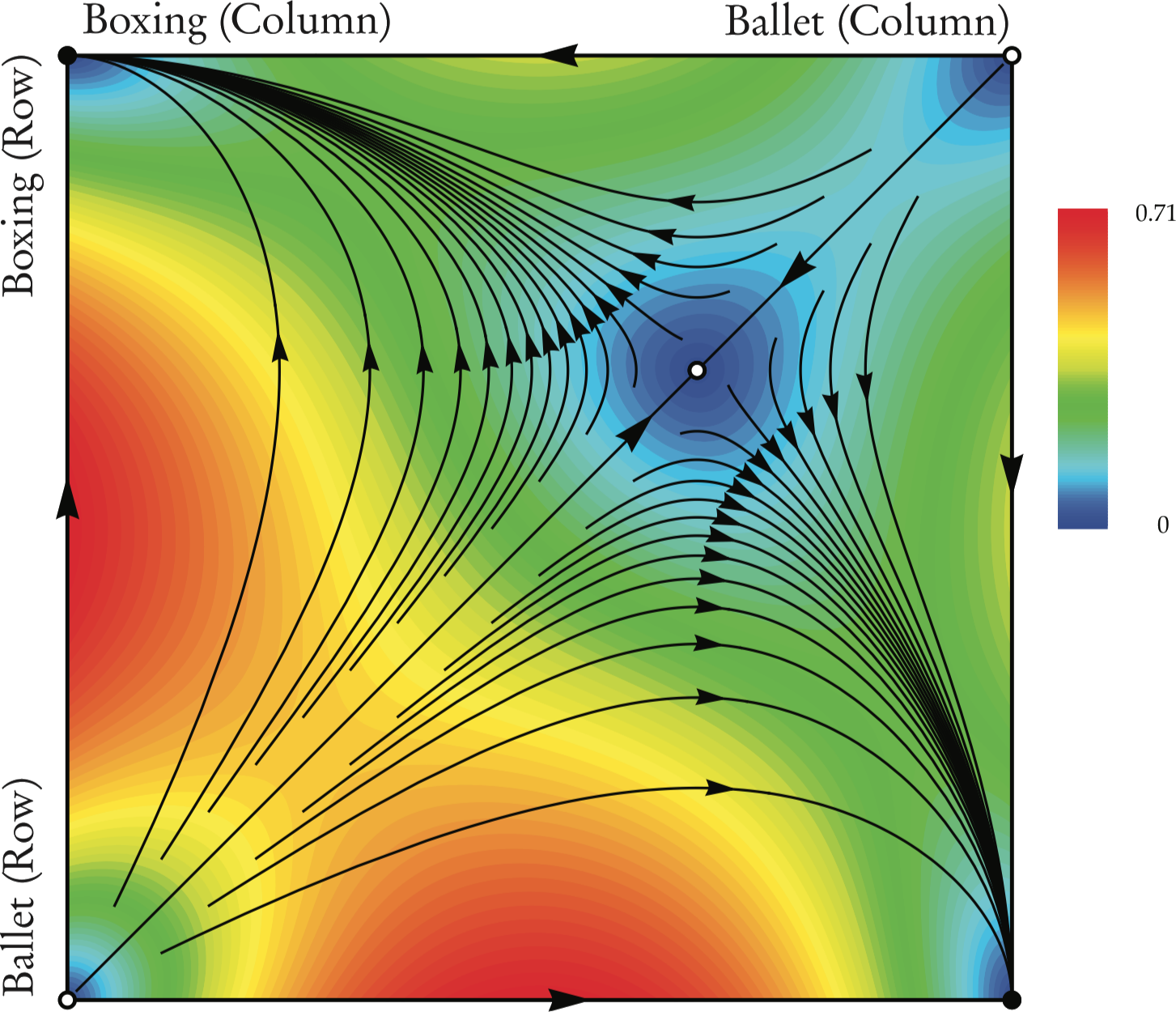
In The Dynamics of Rational Deliberation, \citep{Skyrms:1990} showed how evolutionary game theory could help us solve the equilibrium selection problem, in some cases.
This figure shows the two-population replicator dynamics for the game:
| Boxing | Ballet | |
| Boxing | (2,1) | (0,0) |
| Ballet | (0,0) | (1,2) |
Each population represents a player.
Evaluation
Claim: This succeeds as a “how-possibly” explanation.
Why? Because we didn’t know if it was possible for boundedly rational agents to learn to play a Nash equilibrium prior to doing the research.
The model helped us to imagine how Bayesian rational agents, through mutual, reiterated updating, converge on an equilibrium.
Also: the suboptimal mixed-strategy Nash equilibrium is selected with probability 0, which intuitively seems the right outcome.
Evolution of fair division (case 1)
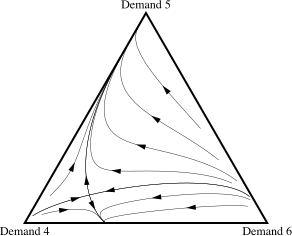
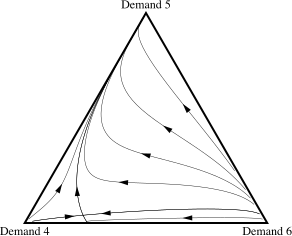
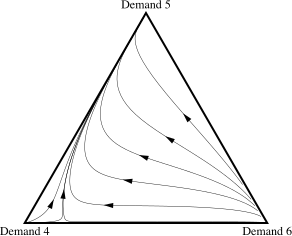
In Evolution of the Social Contract, Skyrms showed how the replicator dynamics, with correlation, selects the unique Nash equilibrium corresponding to our moral intuitions.
Instead of the general problem of equilibrium selection, this concerned selecting a particular equilibrium.
Evaluation
Claim: This mostly succeeds as a “how-possibly” explanation.
We didn’t know how the equilibrium selection problem could be solved in the case of the Nash demand game, picking the “intuitively right” outcome.
Problem: What justifies the correlation? (See D’Arms, Batterman and Górny, 1998, for a discussion of why this matters.\nocite{DArms/etal:1998})
This is why it mostly succeeds.
Evolution of fair division (case 2)
Evaluation
Claim: This mostly succeeds as a “how-possibly” explanation.
Strengths:
- The social network provides an endogenous account of the correlation needed for fairness to evolve.
- The finite population provides greater realism than the continuous replicator dynamics.
- \citet{Alexander:2007} shows the account does not depend on the exact social network used.
Evaluation
Claim: This mostly succeeds as a “how-possibly” explanation.
Weaknesses: Some (many?) but note that standard objections assume “why-actually” explanation rather than “how-possibly”.
- Little empirical evidence for the specific network structure.
- The symmetric Nash demand game is rarely played in real life.
- A single type of player does not reflect the diversity of real populations.
- Do people use imitate-the-best to learn?
Etc.
Methodological drift
Methodological drift
Methodological drift occurs when modelling techniques appropriate for one type of problem are applied to related problems that are similar but not the same.
The goodness-of-fit between the modelling method and the target system may not be as strong as previously.
Confidence in the modelling method — raised by previous successes — may lead one to incorrectly assess the quality of the explanation provided.
In the next examples, think about how the boundary between how possibly and how actually explanations are blurred.
Example 1: Epistemic Diversity
The benefits of epistemic diversity
\citep{Hong/Page:2004}
Hong and Page describe a “computational experiment” which, they claim, shows that “diversity trumps ability”.
Setup.
Let $f$ be a random function which maps $\{1,\dots,n\}$ into $[0,100]$. This is the objective function which agents seek to maximize.
Let $a_i \in \mathbb{Z}_n$ denote the location of agent $i$ in the space. Agent $i$ can see the value of $f(a_i)$.
Each agent has their own heuristic they use to search, in order to try to find the maximum value of $f$.
The benefits of epistemic diversity
\citep{Hong/Page:2004}
Let $1\leq l < n$ and $1\leq k < l$. A heuristic is a $k$-tuple $(\phi_1,\dots,\phi_k)$ with $\phi_i\in\{1,\dots,l\}$.
Consider $n=200, k=3$, and $l=12$. [An agent] with the heuristic $(1,4,11)$ starting at point 194 would first evaluate point $195(194+1)$ and compare with 194. If point 194 had a higher value, she would then evaluate point $198(194+1)$. If point 198 had a higher value, she would then check point $9(198+11-200)$. If that point had a higher value, she then would evaluate point $10(9+1)$. She would keep evaluating until none of her three checks located a higher value. \citep[pg. 16386]{Hong/Page:2004}
The benefits of epistemic diversity
\citep{Hong/Page:2004}
Simulations use a relay-race model, involving groups: one agent finds the best point she can, then hands over the search to a new agent, starting at the last best point found.
The data show that, on average, the collective performance of the randomly selected agents significant outperforms the group of the best agents [\ldots] diversity is the key to collective performance. \citep[pg. 16386]{Hong/Page:2004}
The benefits of epistemic diversity
\citep{Hong/Page:2004}
Hong and Page then prove a theorem which attempts to explain why the computational experiment has the results in has. (But see Thompson, 2014\nocite{Thompson:2014} for a powerful critique.)
Our result provides insights into the trade-off between diversity and ability […] A further implication of our result is that, in a problem-solving context, a person's value depends on her ability to improve the collective decision […] Thus, even if we were to accept the claim that IQ tests, Scholastic Aptitude Test scores, and college grades predict individual problem-solving ability, they may not be as important in determining a person's potential contribution as a problem solver as would be measures of how differently that person thinks. Our result has implications for organizational forms and management styles…
Evaluation
Claim: This doesn’t succeed as a how-possibly explanation.
Why?
- We don’t experience “imaginative frustration” \citep{Brainard:2020} about why diverse groups might perform well.
- The search problem and heuristics don’t even approximate real-world problems.
- The definition of a heuristic assumes that two people who think the same cannot do better than one person.
Claim: It doesn’t succeed as a why-actually explanation, either.
Optimal outcomes on epistemic networks
\cite{Zollman:2007,Zollman:2010}
- A multi-arm bandit is a slot machine with $N$ arms.
- Arm $i$ wins with probability $p_i$.
- Assume: payoffs are the same for all arms.
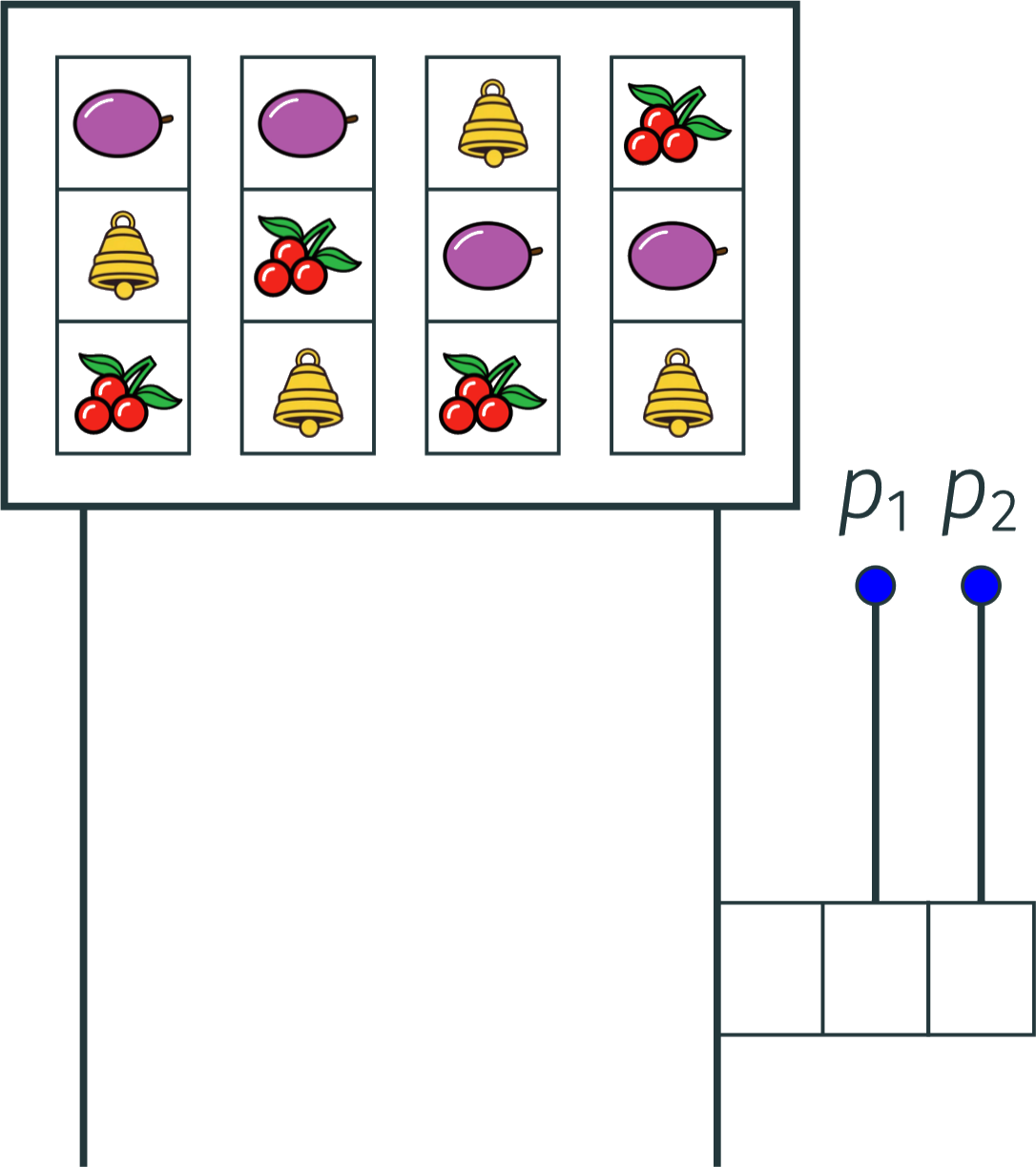
Each arm represents a theory; winning represents making a correct prediction.
Optimal outcomes on epistemic networks
\cite{Zollman:2007,Zollman:2010}
Suppose scientists have to decide between two theories, $A$ and $B$.
Theory $A$ makes a correct prediction with probability $p_A = 0.5$.
Theory $B$ makes a correct prediction with probability $p_B = 0.5 + \phi$, for $\phi \in [0,0.5]$.
However, the scientists don’t know this.
Each scientist begins with a random belief as to whether $A$ or $B$ is better: an initial probability, between 0 and 1, that theory $B$ is better.
Optimal outcomes on epistemic networks
\cite{Zollman:2007,Zollman:2010}
Scientists pick a theory to try at random, according to their degree of belief.
Scientists compare their results with the results of their neighbours in an epistemic network, and use Bayesian updating to adjust their degree of belief as to whether theory A or B is better.
Sparser network structure can be beneficial. (That is, less information can be better than more information.) Although higher connectivity yields faster convergence, sparser networks are more likely to arrive at the correct belief.
Evaluation
Fragile
Example 2: Intersectional disadvantage
The emergence of intersection disadvantage
\citet{OConnor/etal:2019}
In their model, O’Connor et al. consider a simplified bargaining game. Suppose there is a resource of size 10, and people have to decide how to share it.
People have a strategy: Low (L), Medium (M), or High (H).
Suppose $M=5$ and that $L+H = 10$.
For two players, there are three rational outcomes:
- $(L,H)$
- $(M,M)$
- $(H,L)$
The emergence of intersection disadvantage
\citet{OConnor/etal:2019}
In addition, suppose that the population is partitioned along two different dimensions, with two categories along each dimension.
In the paper, O’Connor et al. refer to these categories using standard examples, e.g.,
- Men/Women
- White/Black
But, in truth, they could be anything.
The emergence of intersection disadvantage
\citet{OConnor/etal:2019}
How do the evolutionary dynamics operate?
Suppose that this population regularly engages in two sorts of bargaining scenarios, for each of which only one of their identities becomes salient. For example, one arena of bargaining could occur in the workplace over salary, benefits, or workload and, in this arena, race could be particularly salient to the actors. Another arena of bargaining could occur in the marketplace over the cost of goods, and for this gender could be more salient. O’Connor, 2019, pg. 29
An even more simplified bargaining game
Minimal intersectionality
Here, O’Connor et al. note (emphasis mine): “To keep things tractable, we will focus on an even smaller version of the Nash demand game, where actors may only demand High or Low.”
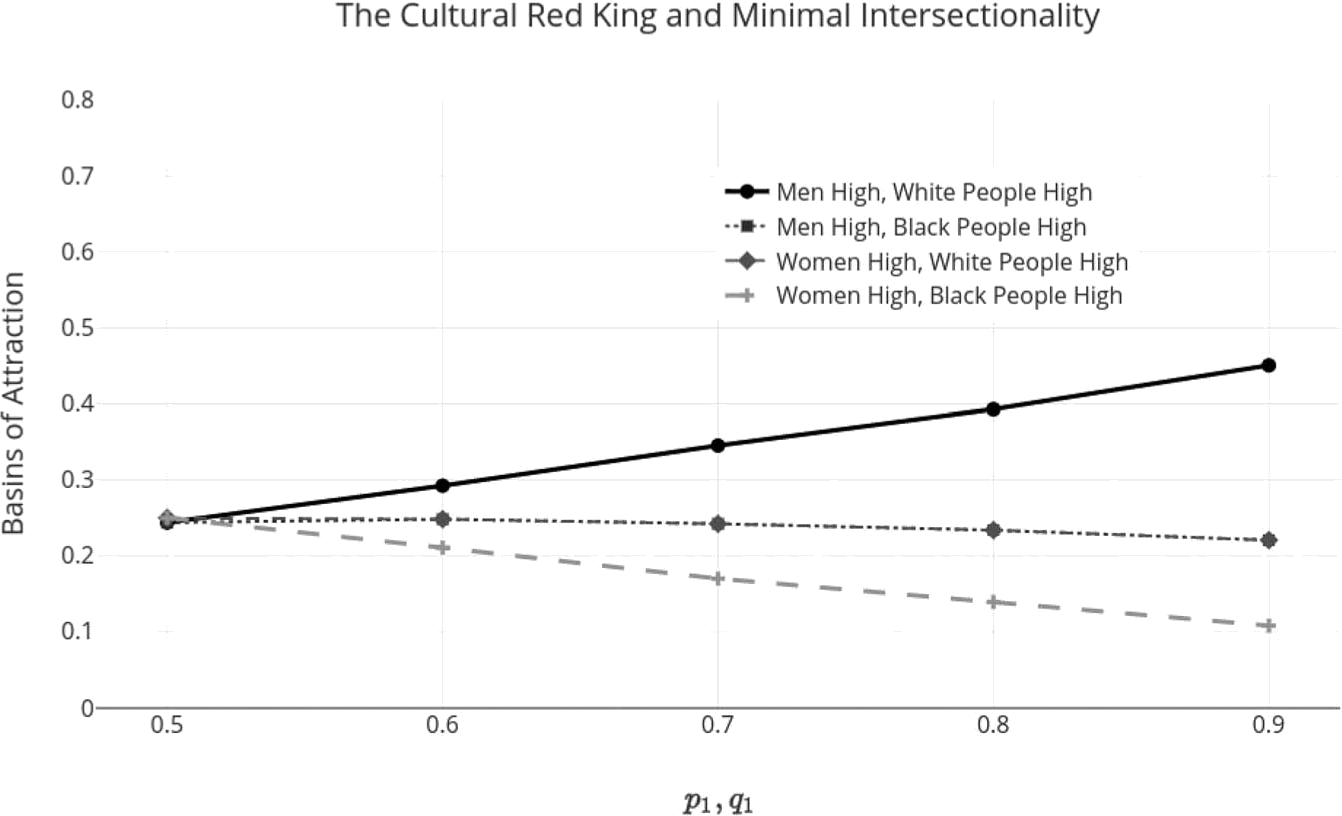
Figure 3. Proportions of four possible joint outcomes for minimally intersectional populations.
Introducing biased learning rules
Moderate intersectionality
Now assume, though, that actors only learn socially from those in their intersectional type. At the market, for example, white men do not assume that any man is a good role model for them (even though gender is salient for interaction), but only adopt role models who also share their race. O’Connor et al., 2019, pg. 31
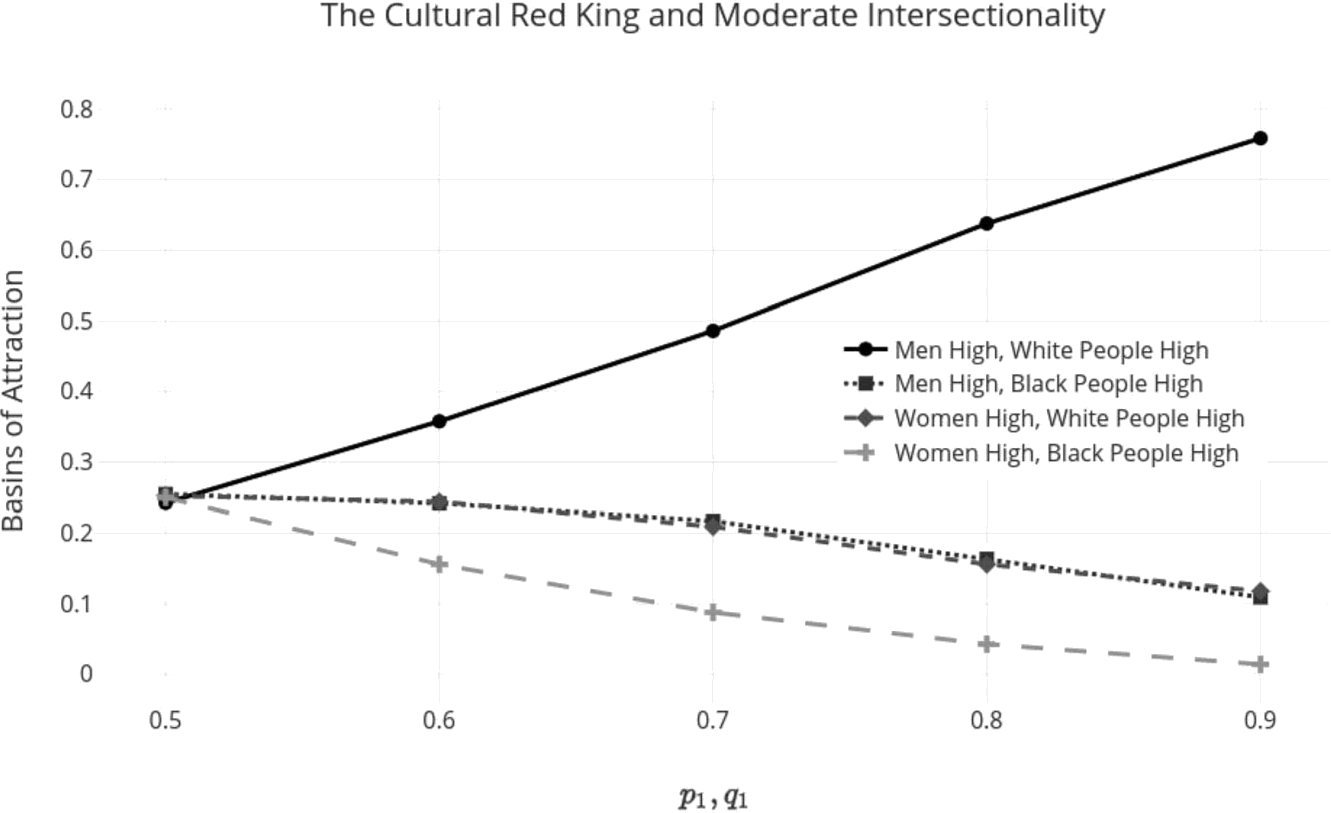
Figure 4. Proportions of four possible joint outcomes for moderately intersectional populations.
An even more simplified bargaining game, III
Strong intersectionality
We now assume that there is just one arena of interaction for our intersectional groups, and that within this arena only intersectional identities are salient for interaction. In other words, the individuals pay attention to intersectional identities in determining both (1) how to interact with bargaining partners and (2) which role models to choose.
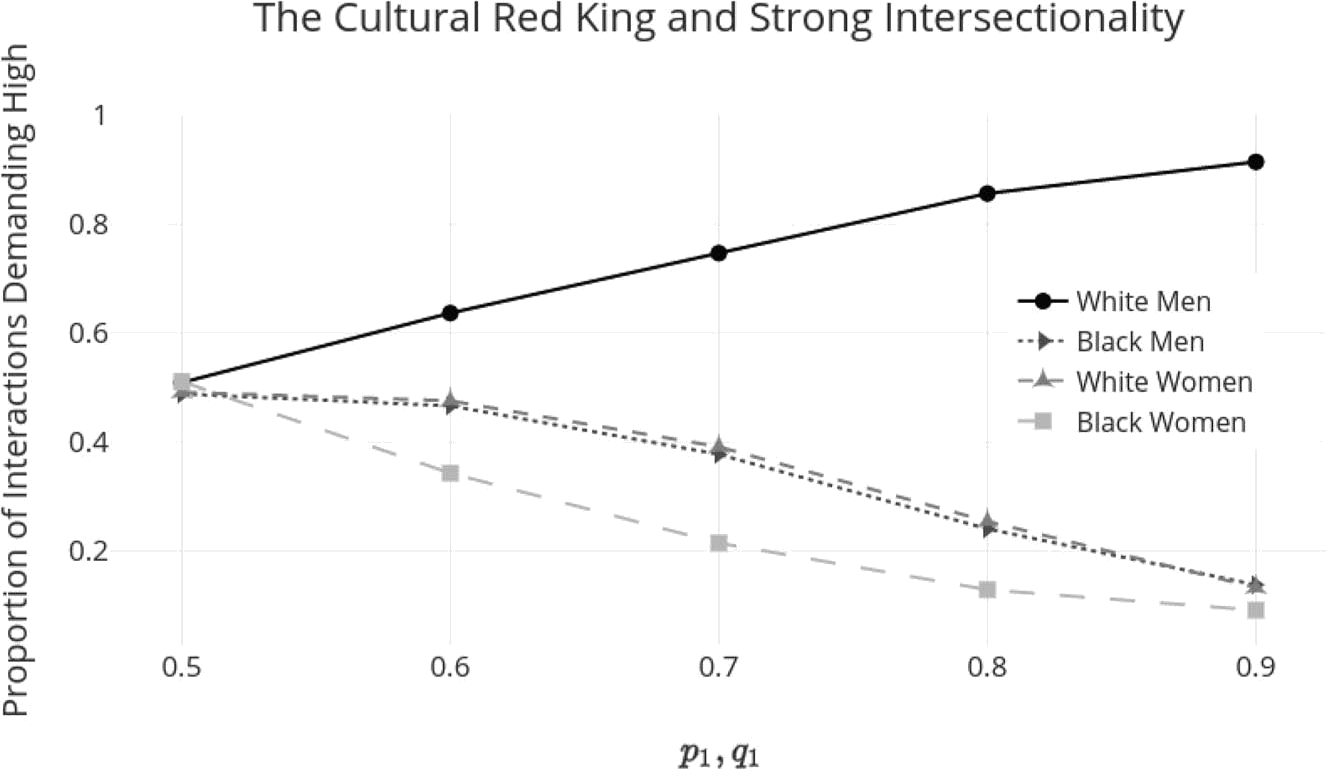
Figure 5. Average proportion of high demands for strongly intersectional populations.
Critical reflection, I
Consider what’s likely driving the results.
Critical reflection, II
Is the correct interpretation really what they impute? Recall:
[S]imply by dint of small numbers alone, members of a minority group can be disadvantaged in the emergence of bargaining. O’Connor et al. (2019, pg. 27)
- What is driving the result is simply the relative proportion of the size of the two groups.
- The fact that the labels are “Black/White” and “Men/Women” are used encourages one read into the model connections with racism or patriarchy, but that goes beyond the formalism.
Critical reflection, III
\cite{Zucker/etal:2019} consider variation of the O’Connor et al. model, allowing for more strategies.
They find, in some cases, “minorities may actually be advantaged and intersectional minorities greater than additively advantaged”.
Conclusion
Conclusion
- Whereas early evolutionary game theory models clearly aimed at “how-possibly” explanation — because we were often ignorant — later evolutionary game theory models target phenomena where we know a lot more.
- In addition, later work targets phenomena which require complex causal knowledge (group diversity) or rich semantic content (intersectionality) to understand.
- In these cases, “how-possibly” explanations are offered, when people want “why-actually” explanations.
- I worry that the mathematical exactitude of these formal models can mislead some as to what has actually been shown.