London School of Economics and Political Science
Outline
\[ I_j = I_j(a_j, a_{-j}; c_j, \epsilon_j, P) \]
Social identity and the theory of games
A theory of social identity
In what follows, I will adopt a theory of identity developed by Bikhu Parekh.\nocite{Parekh:2008,Parekh:2009} According to his theory, human identity has two components:
- Personal identity
- A person’s “distinct [centre] of self-consciousness” that gives that person “an ineliminable inner life and a distinct sense of selfhood or subjectivity” \citep[pg. 268]{Parekh:2008}.
A theory of social identity
In what follows, I will adopt a theory of identity developed by Bikhu Parekh.\nocite{Parekh:2008,Parekh:2009} According to his theory, human identity has two components:
- Social identity
- “As social beings, human beings are involved in a variety of relationships, occupy different roles, and are members of different organizations, groups, and communities. They identify themselves to, and are in turn identified by, others of terms of these. The range of social classification and the categories to which it gives rise are virtually limitless, and can be based on almost [anything].” \citep[pg. 272]{Parekh:2008}.
Social identity and the theory of games
\cite{Akerlof/Kranton:2000} introduced identity into economic analysis, noting that it matters for four reasons:
- “Identity can explain behaviour that appears detrimental. People behave in ways that would be considered maladaptive or even self-destructive by those with other identities.”
- “Identity underlies a new type of externality. One person’s actions can have meaning for and evoke responses in others.”
- “Identity reveals a new way that preferences can be changed. Notions of identity evolve with a society and some in the society have incentives to manipulate them.”
- “Because identity is fundamental to behavior, choice of identity may be the most important ‘economic’ decision people make.”
The Akerlof/Kranton framework
Let $C = \set{C_1, \dots, C_k}$ denote a set of social categories pertaining to the set of players $N = \set{1,\dots, n}$.
For each individual $j$, let \[ c_j: N\to \mathscr{P}(C) \] denote player $j$’s ascription of social categories to all players. (Each player has a conception of their own social categories as well as that of others.)
Let $P = \set{P_1, \dots, P_k}$ be a set of prescriptions, i.e., behavioural characteristics thought “appropriate” for each category.
The Akerlof/Kranton framework II
Each player has a utility function:
\[ U_j = U_j(a_j, a_{-j}, I_j) \]
- Each player’s utility depends on their action $a_j$.
- Each player’s utility depends on the actions of others $a_{-j}$.
- Each player’s utility depends on their identity $I_j$.
A player’s identity is defined as follows:
\[ I_j = I_j(a_j, a_{-j}; c_j, \epsilon_j, P) \]
where $\epsilon_j$ denotes $j$’s actual characteristics, which may vary considerably from the prescriptions in $P$.
The Akerlof/Franton framework III
\[ U_j = U_j(a_j, a_{-j}, I_j) \]
\[ I_j = I_j(a_j, a_{-j}; c_j, \epsilon_j, P) \]
Philosophical research has explored some of the functional interdependencies identified by Akerlof and Kranton, but not all.
In what follows, I will identify some extensions of the Akerlof/Franton framework which allow for an even greater dynamism between identity and strategic choice.
The Akerlof/Franton framework IV
\[ U_j = U_j(a_j, a_{-j}, I_j) \]
\[ I_j = I_j(a_j, a_{-j}\cssId{id1}{;} c_j, \epsilon_j, P) \]
- The parameters $c_j$, $\epsilon_j$, and $P$ are taken as given and static.
- Yet in repeated games, they may have functional dependencies on prior actions of the players.
- This means they themselves are candidates for strategic intervention by the players.
The Akerlof/Franton framework IV
\[ U_j = U_j(a_j, a_{-j}, I_j) \]
\[ I_j = I_j(a_j, a_{-j}; \cssId{id2}{c_j}, \epsilon_j, P) \]
- As \cite{Hacking:1996,Hacking:1999a,Hacking:1999} observed, new social categories can emerge.
- They can also be deliberately constructed for strategic reasons.
- And different categorisations can be made salient to induce ingroup/outgroup bias deliberately.
The Akerlof/Franton framework IV
\[ U_j = U_j(a_j, a_{-j}, I_j) \]
\[ I_j = I_j(a_j, a_{-j}; c_j, \cssId{id3}{\epsilon_j}, P) \]
- The actual characteristics of a player (resources, preferences, beliefs) is a product of their history.
- Both preferences and beliefs(!) may depend on the social categories ascribed to a player by others.
The Akerlof/Franton framework IV
\[ U_j = U_j(a_j, a_{-j}, I_j) \]
\[ I_j = I_j(a_j, a_{-j}; c_j, \epsilon_j, \cssId{id4}{P}) \]
- The prescriptions (which include social norms, stereotypes, expectations, etc.) are virtually never under our control.
- In some cases (e.g., emergent social norms), there is no explicit “owner” of the prescription responsible for its current state.
- Yet in other cases, a single leader (or group of oligarchs) set the standards for all.
Three extensions
Authenticity ($\epsilon_j, P$)
Authenticity
\[ I_j = I_j(a_j, a_{-j}; c_j, \style{fill:red}{\epsilon_j}, \style{fill:red}{P}) \]
When considering the prescriptions attached to a social category, one aspect which often matters is whether one is a bona fide member of the group.
We have often heard expressions like:
- “You’re a Republican in name only!”
- “You’re not a real believer!”
- “You’re just a champagne socialist!”
These are claims about inauthentic behaviour.
Authenticity II
\[ I_j = I_j(a_j, a_{-j}; c_j, \style{fill:red}{\epsilon_j}, \style{fill:red}{P}) \]
When authenticity matters, player $j$ worries about potential mismatch between $\epsilon_j$ and the prescriptions in $P$.
This may lead to behavioural adjustment — e.g., Hacking’s looping effect, Bicchieri’s social norms — but also new character traits and dispositions.
Question: Who determines the content of $P$?
Authenticity III
An example
\[ I_j = I_j(a_j, a_{-j}; c_j, \style{fill:red}{\epsilon_j}, \style{fill:red}{P}) \]
Which U.S. President’s legislative agenda included the following:
- Creating the Environmental Protection Agency (EPA).
- Creating the Occupational Safety and Health Administration (OSHA).
- Passing the Clean Air Act.
- Passing the National Environmental Policy Act.
- Creating the first major federal affirmative action programme.
- Endorsed the Equal Rights Amendment (ERA).
Answer: Nixon, a Republican.
Authenticity IV
\[ I_j = I_j(a_j, a_{-j}; c_j, \style{fill:red}{\epsilon_j}, \style{fill:red}{P}) \]
Today, numerous examples illustrate how a single agent (or, in some cases, a small group of oligarchs) have radically altered $P$ to suit their aims.
This means we need to change how $P$ is conceptualised: \[ P \to P^{t+1}(a_j^t, a_{-j}^t, P^t) \]
And this means $P$ becomes a strategic target.
Authenticity V
\[ \begin{align*} I_j = I_j(a_j, a_{-j}; c_j, \style{fill:red}{\epsilon_j}, \style{fill:red}{P}) \\ P \to P^{t+1}(a_j^t, a_{-j}^t, P^t) \end{align*} \]
Problems:
- Commitment to an identity combined with the sunk cost fallacy leaves individuals strategically vulnerable to manipulation by others.
- A desire to be accepted as authentic can lead to over-adjustment of people’s behaviour. E.g., why recent religious converts tend to be over-represented among radicalised extremists involved in terrorism (Jones, 2020; Jones and Dawson, 2023). \nocite{Jones:2020,Jones/Dawson:2023}
- Counterintuitively, ‘authenticity’ can interfere with people’s freedom and autonomy.
Intersectionality ($c_j$)
Intersectionality
\[ I_j = I_j(a_j, a_{-j}; \style{fill:red}{c_j}, \epsilon_j, P) \]
The concept of intersectionality was first introduced by \cite{Crenshaw:1989} to understand the non-additive nature of discrimination.
I use the term to refer to the fact that all individuals belong to multiple social categories at the same time — and so it is not restricted to discrimination.
Why does this matter?
From social identity theory we know that when social categorisations are made salient, ingroup/outgroup bias are easily generated. \nocite{Tajfel:1970,Tajfel:1978,Tajfel/etal:1979}
Intersectionality II
\[ I_j = I_j(a_j, a_{-j}; \style{fill:red}{c_j}, \epsilon_j, P) \]
This requires one important change to the Akerlof/Kranton framework:
\[ c_j: N\to \mathscr{P}(C\times \mathbb{R}) \]
Each player’s assignment of social categories to others has a salience attached.
But these saliences are susceptible to strategic manipulation.
Cambridge Analytica
\[ \begin{align*} I_j = I_j(a_j, a_{-j}; c_j, \style{fill:red}{\epsilon_j}, \style{fill:red}{P}) \\ c_j: N\to \mathscr{P}(C\times \mathbb{R}) \end{align*} \]
In 2018, news reports into the mishandling of data gathered by Facebook and other organisations made headlines. It transpired that the company Cambridge Analytica was using that data to target voters in elections.
Today in the United States we have somewhere close to four or five thousand data points on every individual […] So we model the personality of every adult across the United States, some 230 million people. (Alexander Nix, CEO of Cambridge Analytica, 2016)
Salience can be engineered to induce conflict or cooperation.
Divide and conquer
\[ \begin{align*} I_j = I_j(a_j, a_{-j}; c_j, \style{fill:red}{\epsilon_j}, \style{fill:red}{P}) \\ c_j: N\to \mathscr{P}(C\times \mathbb{R}) \end{align*} \]
When do intersectional identities become independent identities?
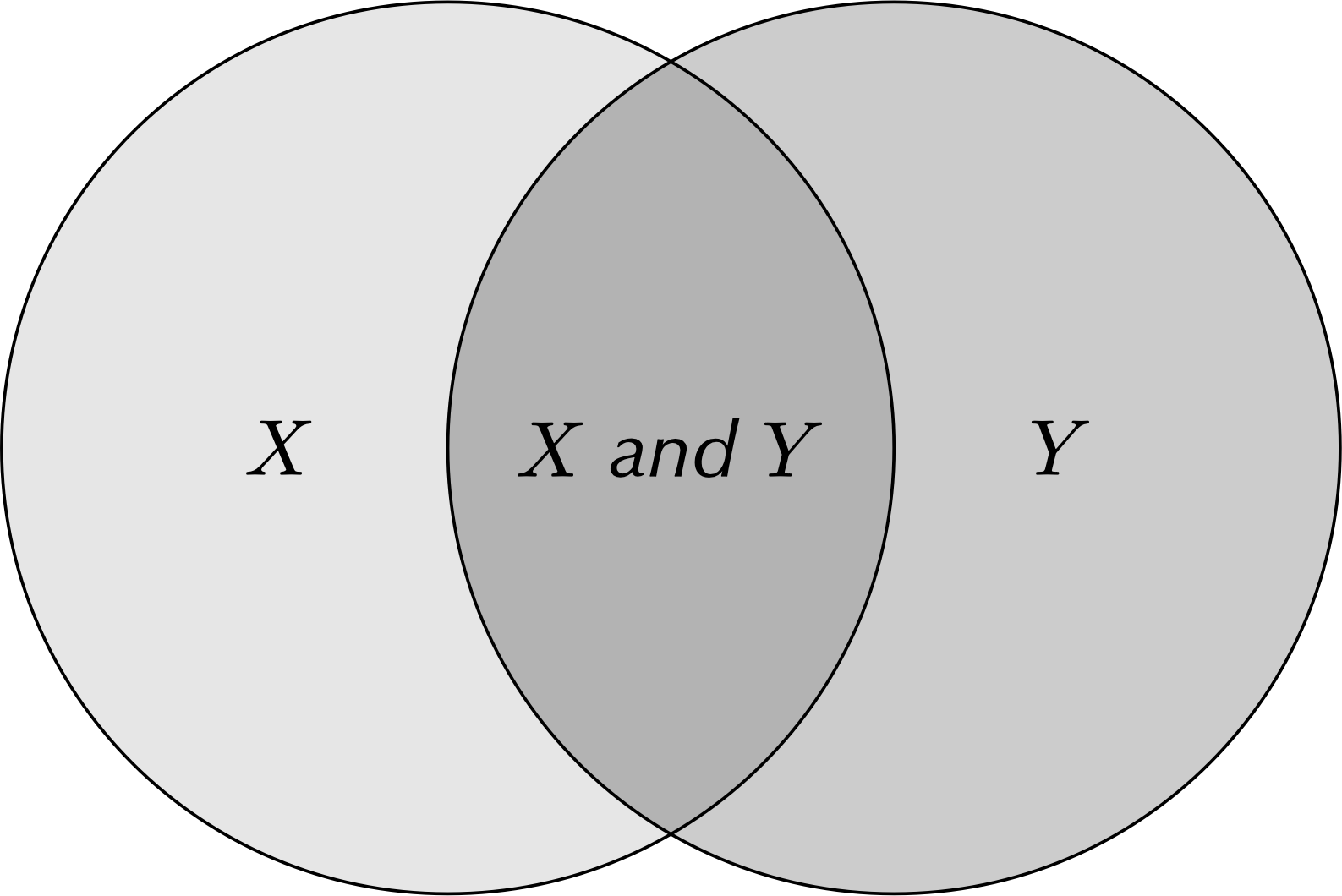
Original intersectional identities
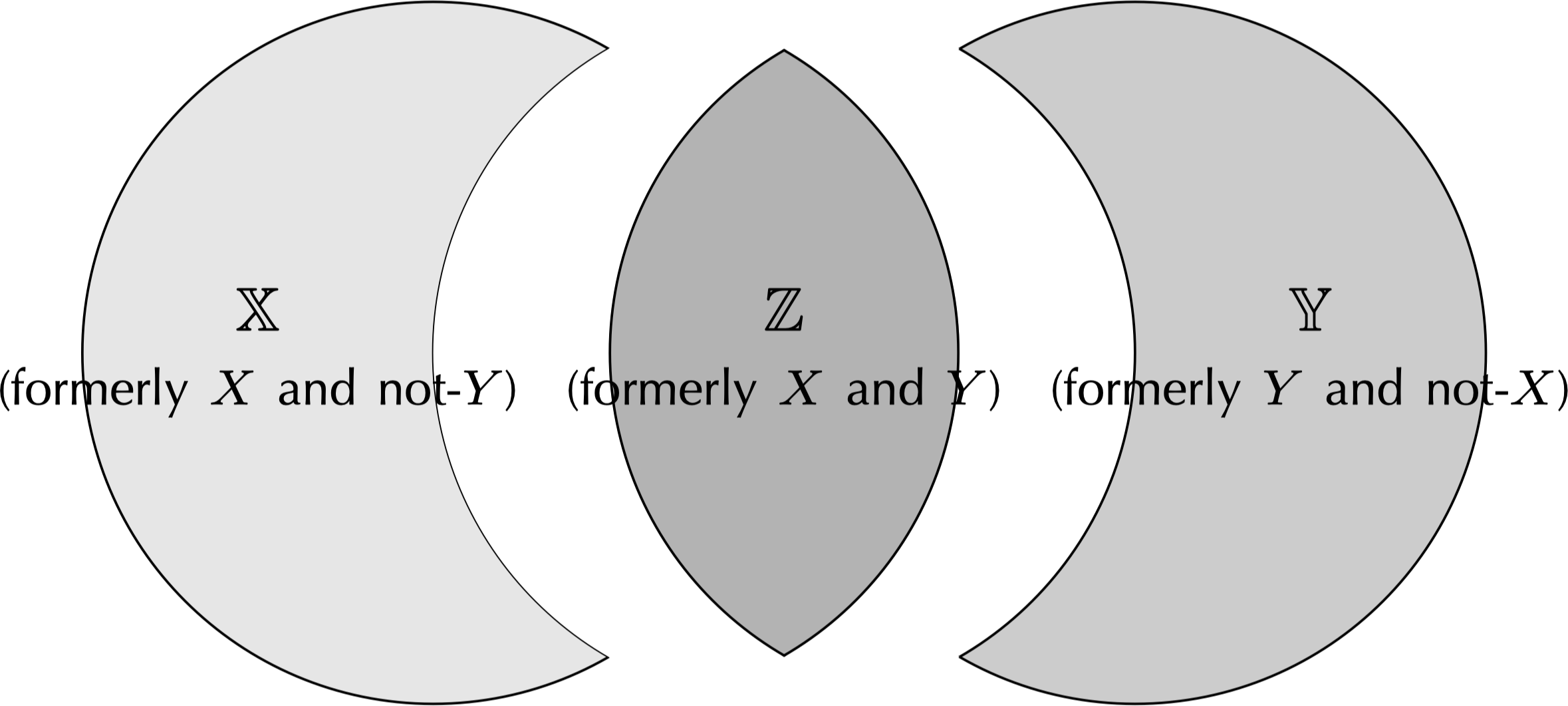
Independent (“rebranded”) identities
When social identities fragment, collective action becomes harder because attention is drawn to the differences. Here, the set $C$ itself is a target for strategic manipulation.
One for all
\[ \begin{align*} I_j = I_j(a_j, a_{-j}; c_j, \style{fill:red}{\epsilon_j}, \style{fill:red}{P}) \\ c_j: N\to \mathscr{P}(C\times \mathbb{R}) \end{align*} \]
When conflict between any two group members involves all the group members, the pathways to conflict multiply.
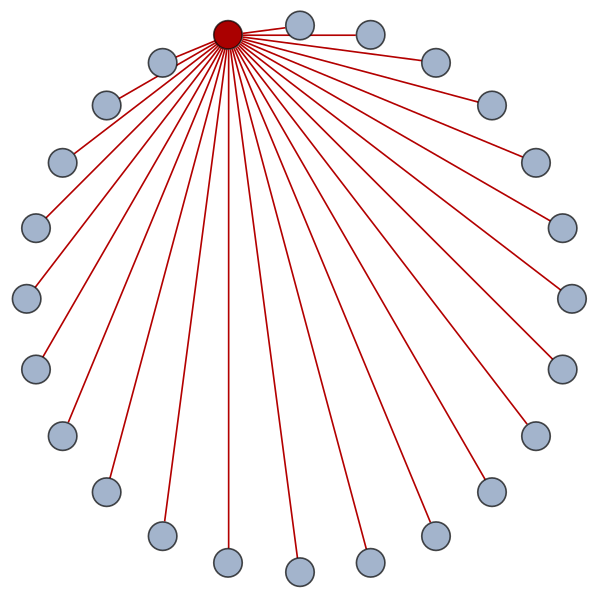
In a group of 24 people, only 23 conflicts can lead to a person getting into a fight.
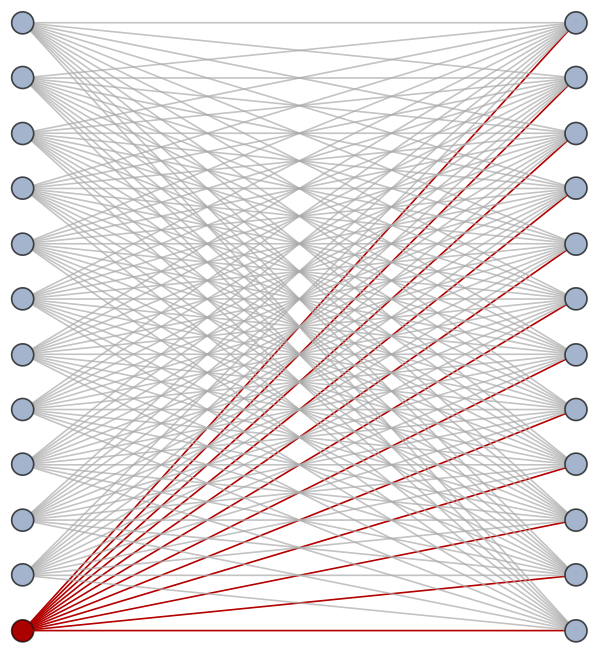
When the group is divided in two, there are 144 conflicts that can lead to a person getting into a fight.
The social nature of belief ($c_j, \epsilon_j$)
The reality we create
\[ I_j = I_j(a_j, a_{-j}; \style{fill:red}{c_j}, \style{fill:red}{\epsilon_j}, P) \]
In 2004, the New York Times journalist Ron Suskind interviewed a senior official in the Bush Administration. The official offered an unusual criticism of people who disagreed with the administration’s policies.
[The reality-based community] believe that solutions emerge from your judicious study of discernible reality. That’s not the way the world really works anymore. We’re an empire now, and when we act, we create our own reality. \citep{Suskind:2004}
The reality we create II
\[ I_j = I_j(a_j, a_{-j}; \style{fill:red}{c_j}, \style{fill:red}{\epsilon_j}, P) \]
A charitable interpretation of what the official said exists.
- They were not denying the existence of objective reality, like rocks and tables, trees and clouds.
- The official meant that, in the context of global politics, the U.S. was such a major player that its actions didn’t just occur in a geopolitical landscape, but they served to create that landscape in the first place.
- This has interesting implications for social behaviour…
The socially extended mind
\[ I_j = I_j(a_j, a_{-j}; \style{fill:red}{c_j}, \style{fill:red}{\epsilon_j}, P) \]
\cite{Clark/Chalmers:1998} not only develop a theory of the extended mind, but they briefly mention the idea of the socially extended mind.
Could my mental states be partly constituted by the states of other thinkers? We see no reason why not, in principle. In an unusually interdependent couple, it is entirely possible that one partner’s beliefs will play the same sort of role for the other as the notebook plays for Otto. \citep[pg. 17]{Clark/Chalmers:1998}
The social model of belief
\[ I_j = I_j(a_j, a_{-j}; \style{fill:red}{c_j}, \style{fill:red}{\epsilon_j}, P) \]
The Clark and Chalmers model of the socially extended mind doesn’t, I think, go quite far enough.
We often outsource the task of determining what to believe to others.
- Whether anthropogenic climate change is happening, and why.
- Which medical treatment to have, when ill.
- The best (or safest) technology to use.
- Important yet esoteric points of religious dogma.
This is the phenomenon of epistemic deferral (not testimony).
Beliefs as signifiers
\[ I_j = I_j(a_j, a_{-j}; \style{fill:red}{c_j}, \style{fill:red}{\epsilon_j}, P) \]
For many social groups, certain beliefs are understood, implicitly or explicitly, to be either constitutive or a requirement of group membership.
Such beliefs serve as signifiers of social identity.
A dual-process theory of belief. Beliefs have:
- A manifest function (the normal epistemic function).
- A latent function (signifying one’s social identity).
This means beliefs (and preferences) are also targets for strategic intervention based on social identity.
Beliefs as signifiers II
\[ I_j = I_j(a_j, a_{-j}; \style{fill:red}{c_j}, \style{fill:red}{\epsilon_j}, P) \]
This dual-process theory matters because conflict can arise between the two functions.
In cases where there is little to no evidence for a belief, that belief can still flourish because of its association with a social identity.
Disinformation and conspiracy theories can spread, because the actual truth-value of many abstract or theoretical beliefs has no bearing on a person’s day-to-day life.
Beliefs as signifiers III
\[ \begin{align*} I_j = I_j(a_j, a_{-j}; c_j, \style{fill:red}{\epsilon_j}, \style{fill:red}{P}) \\ \cssId{id5}{\epsilon_j \to \epsilon_j^{t+1}(c_j^t, P^t)} \end{align*} \]
To make sense of much of social behaviour, we need to move beyond traditional (or even Bayesian) epistemology. We need:
- An evidence-based decision theory (for some cases).
- An identity-based decision theory (for the others).
And a theory which explains what happens when conflict occurs.
This means we need to change how $\epsilon_j$ is conceptualised: \[ \epsilon_j \to \epsilon_j^{t+1}(c_j^t, P^t) \]
Conclusion
Conclusion
Although the Akerlof/Kranton framework for including identity in game theory is a promising start, it doesn’t capture all the functional interdependencies of interest.
Social identity provides several additional points of strategic intervention by agents, and new routes through which agents can be exploited by others.
We need to enhance our understanding of how social identity makes agents strategically vulnerable, to develop a better theory of social behaviour.
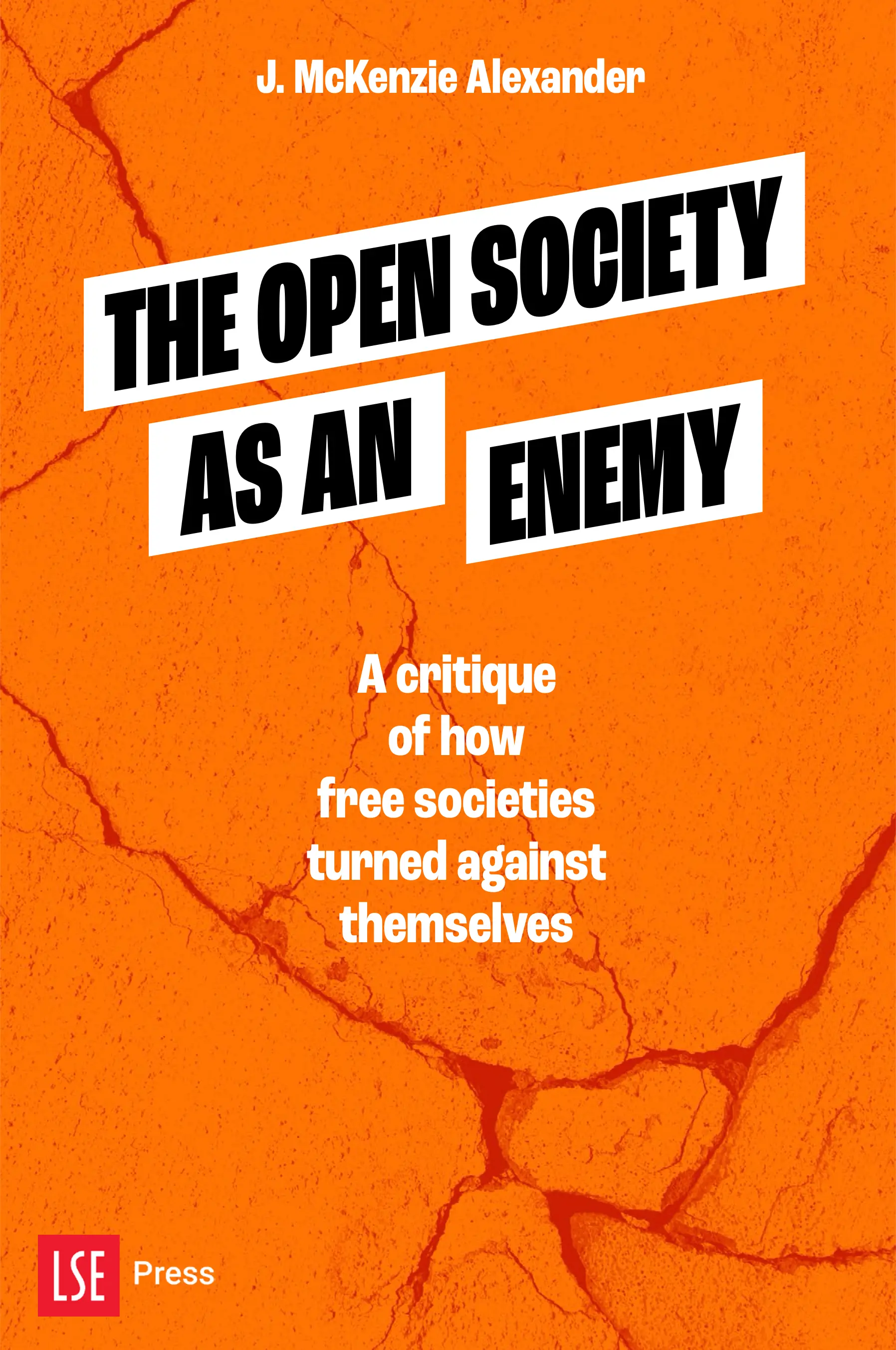
Thank you!
Scan to download