Value: That the free movement of people across borders is generally a good thing, and should be encouraged. Inversion: That immigration is generally a bad thing, and should be restricted or stopped.
The Open Society as an Enemy
A critique of how free societies turned against themselves
Department of Philosophy, Logic and Scientific Method
London School of Economics and Political Science
London School of Economics and Political Science
Outline
Popper’s problem, and ours
The Open Society and its Enemies
In 1945, Karl Popper’s book The Open Society and its Enemies was published by Routledge.
In it, he defended the Open Society against two intellectual threats, each of which had a long legacy.


Why another defence of the Open Society?
Popper’s problem is not our problem. For two reasons.
Reason 1.
- During, and shortly after, World War II it made sense to worry about political ideologies based on historicist worldviews.
-
Now, though, the “will to power” behind many authoritarians doesn’t
tend to invoke such grand metanarratives.
Some do… but you wonder if they really believe it.
Why another defence of the Open Society?
Popper’s problem is not our problem. For two reasons.
Reason 2.
- Popper was concerned with an external threat to the Open Society (Nazism, Communism, etc.).
- Today, we face an internal threat, as citizens of Open Societies reject its principles.
And so we need a new defence, for our time.
What we talk about when we talk about the Open Society
I distinguish four senses of the Open Society:
- Cosmopolitan
- Transparent
- Enlightenment
- Communitarian
And I argue there has been an “inversion of values” in how free societies think of each of these.
Let’s see how.
The value-inversion of the Open Society
Don’t come around here no more
Part I: Don’t come around here no more
The cosmopolitan conception of the Open Society
Part I: Don’t come around here no more
The cosmopolitan conception of the Open Society
Response.
- There’s a powerful moral argument for the free movement of people.
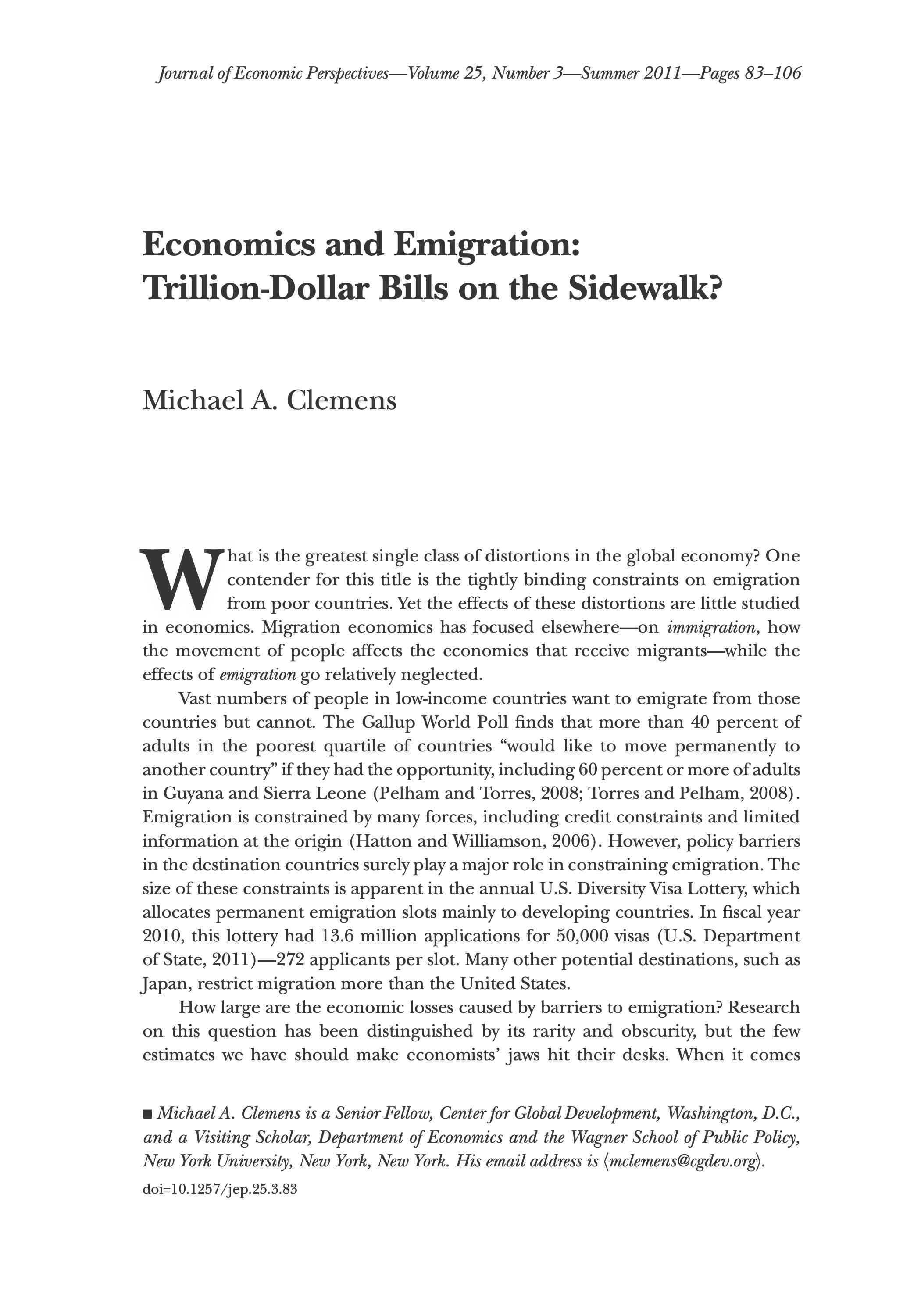
- What about the economic consequences? A number of economic papers say that they’re great!
Part I: Don’t come around here no more
The cosmopolitan conception of the Open Society
Response.
- There’s a powerful moral argument for the free movement of people.
- What about the sociological consequences? The natural experiment provided by the U.S. indicates that, once equilibrium is achieved, they aren’t problematic, either.
Part I: Don’t come around here no more
The cosmopolitan conception of the Open Society
Conclusion: We should be willing to increase — or at least consider increasing — immigration to levels greater than we currently have.
The Panopticon of the Soul
Part II: The Panopticon of the Soul
The transparent conception of the Open Society
Value: Information related to governments, organisations, and institutions should be made widely available, to hold them accountable. Inversion: Information related to the private lives of individuals is permissibly made widely available to corporations, enabling them to profit.
The dangers of radical transparency
The panopticon of the soul is troubling for a number of reasons.
- Harvesting personal information enables nefarious actors to engage in highly targeted “belief engineering” for political purposes (e.g., Cambridge Analytica).
- A world in which nothing is forgotten (e.g., social media) is conducive to poor mental health. It's as if everyone now has HSAM.
- “[P]erhaps the greatest shortcoming of the dystopian novel, 1984, is that Orwell was insufficiently paranoid.”
Safe Spaces
Part III: Safe Spaces
The Enlightenment conception of the Open Society
Value: The free exchange of ideas, rational debate, and critical thinking, even if it makes us uncomfortable, is generally a good thing. Inversion: The free exchange of ideas, if it makes people uncomfortable, is a bad thing and should be restricted.
Modern Tribes
Part IV: Modern Tribes
The communitarian conception of the Open Society
Value: A diverse, multicultural society is generally a good thing, encouraging interactions with people different from one’s self. Inversion: A diverse, multicultural society makes people uncomfortable, encouraging interactions with people similar to one’s self.
Part IV: Modern Tribes
The communitarian conception of the Open Society
Response.
- According to a number of measures, polarisation has increased in society.
- What causes it? A number of theories exist: social media, filter bubbles, echo chambers, safe spaces, etc.
Part IV: Modern Tribes
The communitarian conception of the Open Society
Response.
- Should we be worried about polarisation?
- Yes. Ingroup-outgroup bias is easily generated when group identities are made salient.
- Even when the “group identity” is minimal!
Part IV: Modern Tribes
The communitarian conception of the Open Society
Response.
- Ingroup-outgroup bias can be “weaponised” because people have multiple social identities.
- By choosing which identities to make salient, and when, you can draw people’s attention to conflicting or compatible social identities.
Part IV: Modern Tribes
The communitarian conception of the Open Society
Response.
- Polarised groups can become more extreme over time (the law of group polarisation), especially if people have to prove they are “authentic” members of the group.
- And strange beliefs can take hold because beliefs can serve as signifiers of group membership, even if they are false.
Part IV: Modern Tribes
The communitarian conception of the Open Society
Conclusion: Our social identity presents a thorny challenge.
- On one hand, we are often encouraged to embrace or celebrate our social identities.
- On the other hand, those identities often drive us further apart.
- We need to recognise our common humanity, and prioritise the fact that “society must be intolerant of intolerance”.
Conclusion
Conclusion
I argue that there are many good reasons for rejecting the inversion of values regarding the Open Society.
How do we rehabilitate the Open Society?
This requires a revolution in how we think about things. What kind of revolution is this?
The first revolution is when you change your mind about how you look at things, and see that there might be another way to look at it that you have not been shown. Gil Scott-Heron, interview, 1982
Thank you!