London School of Economics and Political Science
Outline
- Introduction
- Anomalies: The Ultimatum Game
- The Virtual Reality of Homo Economicus
- The philosophical problem
- Two proposals
Four models of economic agents (Pettit, 1995)
In one of this week’s readings, Pettit begins by identifying four different theses of egocentricity found within economic models. These make different assumptions regarding the content of what human beings desire.
- Self-centredness.
- Weak non-tuism.
- Strong non-tuism.
- Self-regardingness.
Self-centredness
This relatively weak claim says that people do what they do as a result of their own desires or utility functions […] they do not act just on the basis of perceiving what other people desire; the perception that someone desires something can lead to action only in the presence of a desire to satisfy that other person. Pettit, pp. 309-10, 1995
Weak non-tuism
“Non-tuism”? tuism literally means “you-ism”, i.e., putting another person’s interests ahead of your own: the opposite of egoism.
This expression derives from writings of the English philosopher Philip H. Wicksteed, who wrote the following about the impersonal nature of economic motivation:
There is surely nothing degrading or revolting to our higher sense in this fact of our mutually furthering each other’s purposes because we are interested in our own. There is no taint or presumption of selfishness in the matter at all […] economy and liberty will be equally valued by altruistic and by egoistic groups or individuals, and it would be just as true, and just as false, to say that the business motive ignores egoistic as to say that it ignores altruistic impulses. The specific characteristic of an economic relation is not its “egoism,” but its “non-tuism.” Wicksteed, 1910
Weak non-tuism
This is a stronger claim, in the sense that it presupposes the first but represents people as intuitively more egocentric still. People's desires bear on how others behave and on what happens to others, so the thesis goes, but such desires are not affected by perceptions of what those agents desire, even for themselves. Pettit, pp. 310, 1995
Strong non-tuism
A stronger claim again: people's desires do not extend, except instrumentally, to others. Not only do people take no account of what others desire in forming their own desires in regard to others; any desires they have for what others should do, or for what should happen to others, are motivated ultimately by a desire for their own satisfaction. Pettit, pp. 310, 1995
Self-regardingness
A thesis that presupposes 1 but represents an alternative way of strengthening it to that represented by 2 and 3. People’s non-instrumental desires may extend to others, and they may be responsive to the perceived desires of others — 2 and 3 may be false — but the more that the desires bear on their own advantage, the stronger they are; in other words, people are relatively self-regarding in their desires. Pettit, pp. 310, 1995
Four economic theses
The relations between the four different theses are shown in the figure to the right.
Four economic theses
The explanatory value of these different economic models ultimately depends on how well they capture real human behaviour.
Question: Do they?
Answer: Sometimes, but not always.
The ultimatum game
Definition
Two players, the Proposer and the Receiver, have to decide how to share a certain amount of money $M$ as follows:
- The Proposer is given $M$ and can offer any amount $0, 1, \dots, M$ to the Receiver. Call this offer $\Omega$.
- The Receiver can Accept or Reject the offer.
- If the offer is accepted, the Receiver gets $\Omega$ and the Proposer gets $M-\Omega$.
- If the offer is rejected, both players get $0$.
The ultimatum game
The standard solution
What should rational players do?
Assuming that something is better than nothing, the Proposer should offer the Receiver the smallest positive amount.
The Receiver should then accept this offer.
The ultimatum game
What people actually do
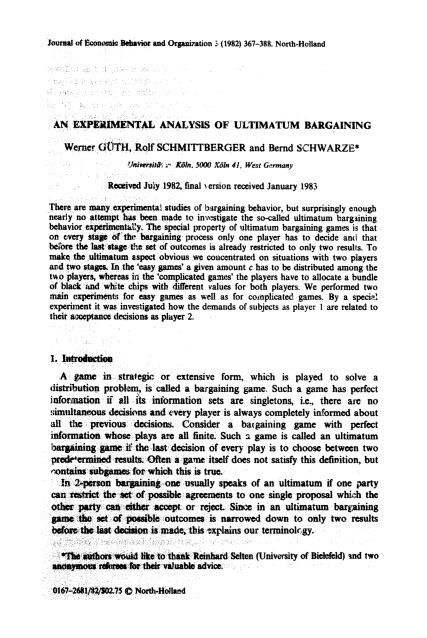
In 1982, Güth, Schmittberger and Schwarze conducted an experiment to see what happened when normal people (i.e., people without training in game theory) played the game, for 4DM.
To their surprise, they found that the modal offer (7 of 21 cases) was 50% and the mean offer was around 40%.
Two people asked for everything, and one of those offers (demands) was accepted.
All other offers were for at least 1DM, with one offer of 1.20DM rejected.
The ultimatum game
What people actually do
The same subjects played the game a second time after having a week’s break.
The offers were less generous, but still inconsistent with the game-theoretic analysis:
- In the second experiment, the mean offer was 37% and only two people offered an even split.
- There was only one offer of less than 1DM, and it was rejected.
- Three offers of 1DM were rejected, as was one offer of 3DM.
Reactions to the original findings
One common reaction was that there wasn’t enough money at stake. If there was “real money” on the table, it was claimed, people would behave differently.
To test this, Hoffman et al. (1996) ran an ultimatum game with monetary stakes of $M=\$100.$ Two different treatments were tested:
- Random assignment of people to Proposer/Receiver roles.
- A contest/exchange treatment, where subjects first answered 10 questions about current events. The subject ranked #1 (Proposer) was paired with the subject ranked #7 (Receiver); the subject ranked #2 (Proposer) was paired with the subject ranked #8 (Receiver), etc.
Hoffman et al. (1996) experiment results
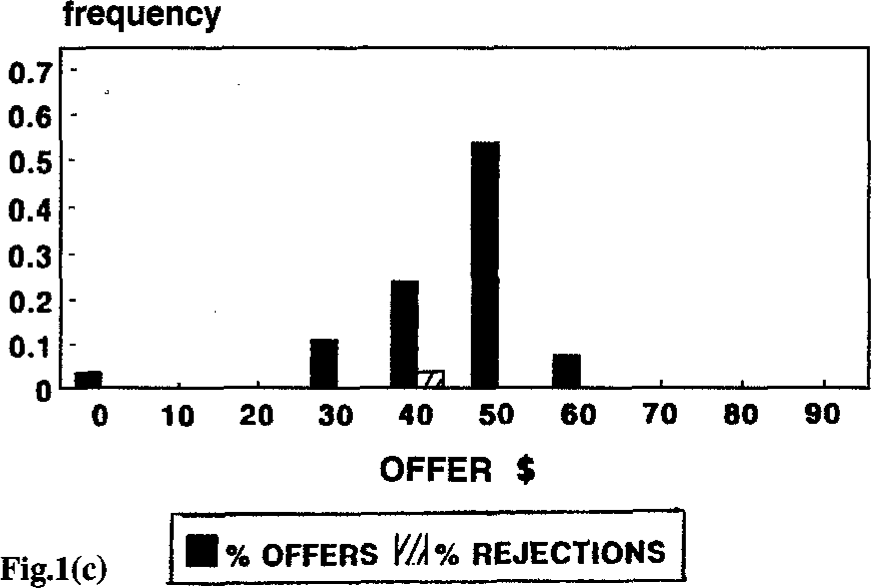
Random assignment
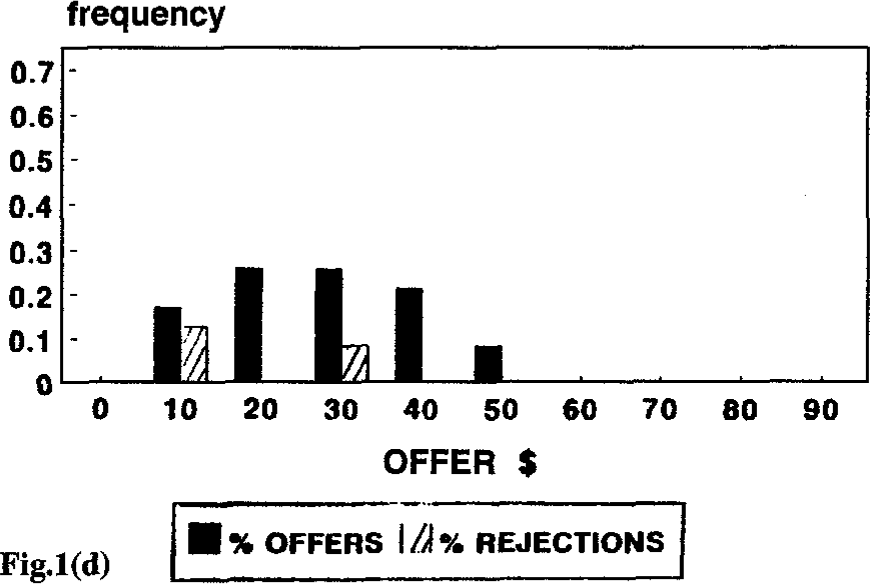
Contest/exchange treatment
Raising the stakes even further
One hundred dollars is a decent amount of money (or it was back in 1996), but was it enough to “really matter”?
Slonim and Roth (1998) ran an experiment in the Slovak Republic, with variation in stake size ranging from 60 Slovak Crowns (SK), to 300SK, to 1,500SK.
With an average hourly wage of 24SK, the amount on the table varied between 2.5 and 62.5 hours of wages.
Slonim and Roth (1998) results
A quick summary of our results is that, consistent with previous ultimatum game results […] we detect no significant difference between low and high stakes proposals or between low and high stakes rejection frequencies when examining inexperienced behavior. Slonim and Roth, pg. 573, 1998
Slonim and Roth (1998) results
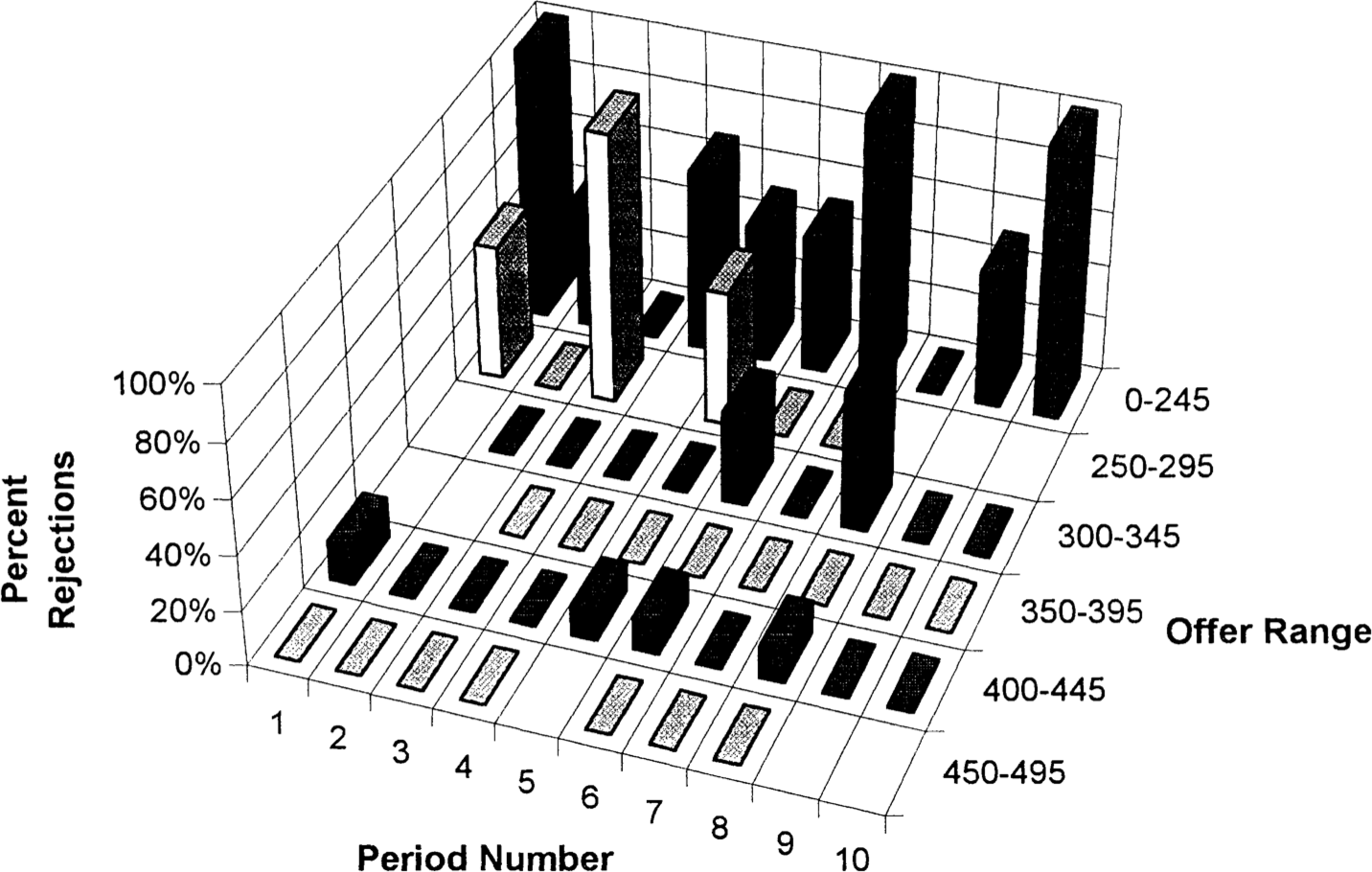
Plot of offers and rejections; a rectangle of no height indicates no offers of that type in that period were rejected.
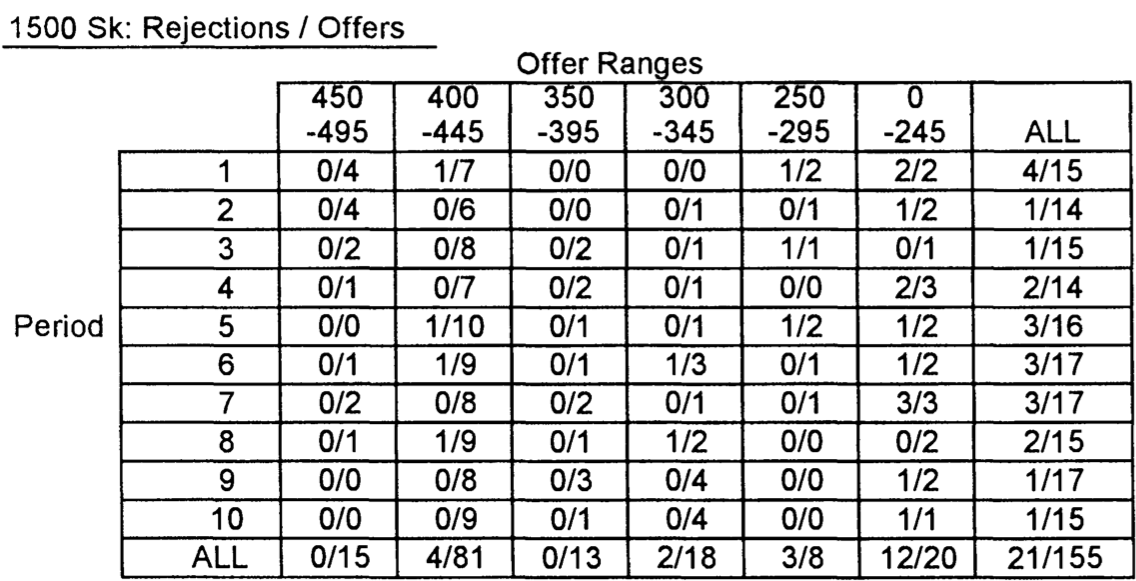
Numerical data for the figure to the left. Subjects were given 1,000 tokens, which were convertible into cash at the end of the experiment, with possible offers in 5 token increments.
Raising the stakes really high
Just to be sure that subject behaviour was really robust in high stakes games, Cameron (1999) reports an experiment conducted in Indonesia in 1994, where:
[T]he per capita gross domestic product (US$670) was less than 3% of that in the United States. Conducting the experiments in Indonesia made it possible to increase the implied monetary stakes to a level much greater than that of previous experiments. The largest stakes used were approximately three times the average monthly expenditure of participants. Cameron, pg. 47, 1999
Cameron (1999) results
How widespread are the findings?
Once it was established that violations of game-theoretic reasoning frequently occurred
and were not an artefact of low-stakes, the question became:
are they culturally relative?
This question was motivated, in part, because experiments revealed that subjects’ behaviour was sensitive to framing effects, and cultural differences can be thought of as an extreme type of framing effect.

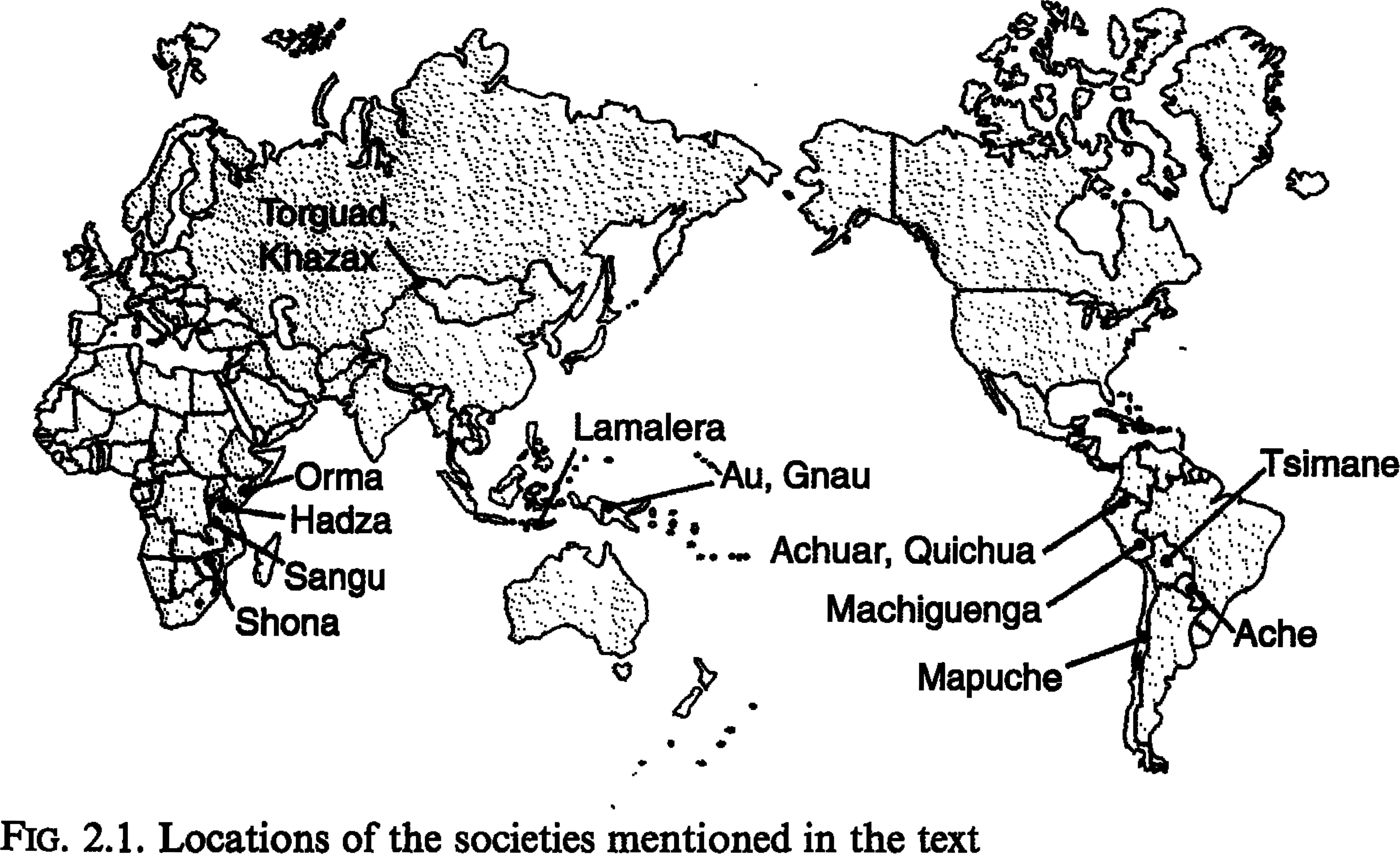
Where the experiments were conducted
What the experiments revealed
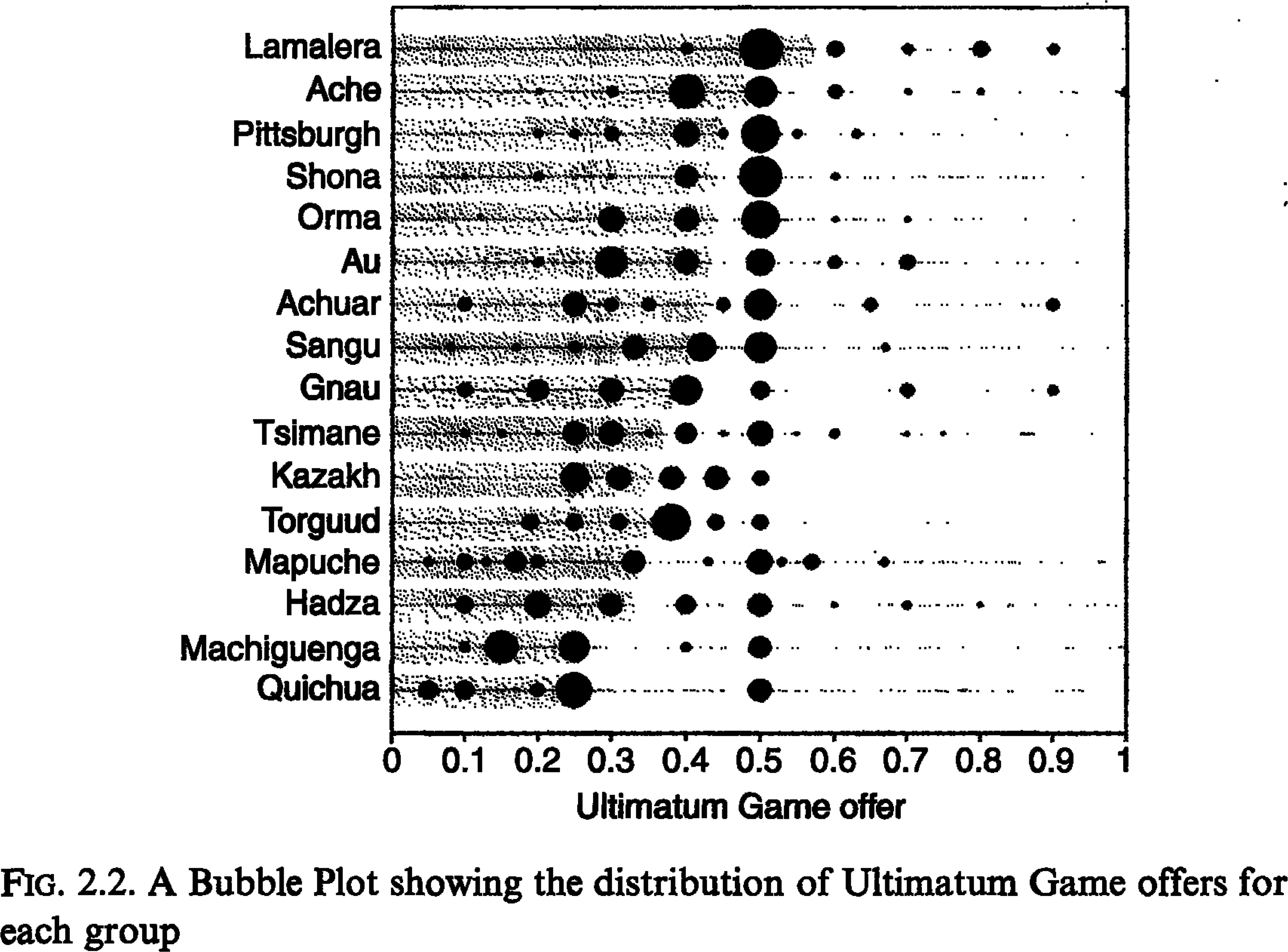
The diameter of each circle represents the proportion of the sample who made that offer.
The rightmost edge of the shaded region is the mean offer of that group.
The underlying philosophical problem
The self-interested nature assumed by economics does not fit with how we understand our motivations and reasoning in ordinary life.
We generally accept that we, and others, act in ways that “transcend and occasionally confound the calls of self-interest” (Pettit, pg. 315, 1995).
Here, Pettit means that we feel our motivation to act often derives from higher motives and abstract concerns, sometimes perhaps even the fact that other people have interests, and not that we have an interest in helping other people achieve their interests.
The underlying philosophical problem
Recall the original contrast regarding motives for action. The claim is that we do not feel like self-regarding agents. I.e., the world is like:
The underlying philosophical problem
Pettit articulates the point quite forcefully, as follows:
The economic mind is that of a relatively self-regarding creature. But the mind that people display towards one another in most social settings, the mind that is articulated in common conceptions of how ordinary folk are moved, is saturated with concerns that dramatically transcend the boundaries of the self. So how, if at all, can the economic mind be reconciled with the common-or-garden mind? Pettit, pg. 316, 1995
A diagnosis of what might be going on
One suggestion is that, although most reasoning takes place as it seems to us, the economic mind is still implicitly present.
The challenge is to make sense of what this would mean. Pettit considers two possible interpretations:
- A focal/peripheral interpretation.
- A virtual/actual interpretation.
Let’s consider each of these in turn.
The focal/peripheral interpretation
Consider how the eye works:
- At the centre of our visual field, everything is in high resolution, showing the maximum level of detail.
- As you move further out, the detail becomes blurrier and you aren't as aware of details. (Like in the graphic, except probably not in black-and-white.)

Painting by Simon Stålenhag.
The focal/peripheral interpretation
Advantages of the interpretation
The model certainly gives us a picture of what it might mean to say that implicitly people are economically minded. It would mean that even as people pay attention to the sorts of concerns engaged in ordinary exchanges with others, even as they keep their eyes on the needs of a friend, the job that has to be done, the requirements of fairness, they in variably conduct some peripheral scanning of what their own advantage dictates that they should do. Pettit, pg 317, 1995
The focal/peripheral interpretation
What it gets wrong:
We all admit […] that weakness of will and self deception are pretty commonplace phenomena. But what the focal-peripheral model would suggest is that the whole of human life is shot through with this sort of failure: that what we take to be a more or less occasional, more or less localised, sort of pathology actually represents the normal, healthy state of the human organism. That is a fairly outrageous claim. Pettit, pg. 318, 1995
The virtual/actual interpretation (allegedly) provides a better answer.
The virtual/actual interpretation
Consider the following question:
Europe has more than 10,873,274 people.
Do you believe that? Yes, of course. 😁 👍 🥳 🎉
Did you ever consider that specific proposition before in your life?
No.
So, could we then say that you didn't really believe that proposition before I asked you right now? 😳 😬 😩
That’s what the virtual/actual distinction is supposed to address.
The virtual/actual interpretation
A virtual belief exists when a person would readily assent to the proposition, if they entertained it.
If a person would not readily assent, if they entertained it, but would assent upon further reflection, then we are more likely to characterise this as a process of belief formation, rather than actualising a virtual belief.
The virtual/actual interpretation
So how does this help?
Homo economicus, according to Pettit, is virtually real in the sense that we are virtually self-regarding agents.
Most of the time, these two models will be behaviourally equivalent.
But when our self-interest becomes threatened, we flip into homo economicus mode and become actual self-regarding agents.
Conclusion
And so we have the following solution:
The common-sense viewpoint is valid to the extent that ordinary folk manage their affairs most of the time without adverting to their own interests; they are guided in their decisions by what is required of them under the cultural framing of the situations in which they find themselves. The economic viewpoint is valid to the extent that even when this is so, even when people are not explicitly self-regarding in their deliberations, still self-regard has a virtual presence; it is there, ready to affect what people do, in the event that any of the alarm bells of self interest ring. Pettit, pg. 323, 1995
Bibliography
Steffen Andersen, Seda Ertaç, Uri Gneezy, Moshe Hoffman, and John A. List (2011). “Stakes Matter in Ultimatum Games.” The American Economic Review, 101(7): 3427-3439.
Lisa A Cameron (1999). “Raising the stakes in the ultimatum game: Experimental evidence from Indonesia.” Economic Inquiry, 37(1): 47–59.
Elizabeth Hoffman, Kevin McCabe, and Vernon Smith (1996). “On Expectations and the Monetary Stakes in Ultimatum Games.” International Journal of Game Theory, 25(3): 289–301.
Bertrand Munier and Costin Zaharia (2003). “High Stakes and Acceptance Behavior in Ultimatum Bargaining: A Contribution from an International Experiment.” Theory and Decision, 53: 187–207.
Philip Pettit (1995). “The Virtual Reality of Homo Economicus.” Monist, 78(3): 308–329.
Robert Slonim and Alvin E. Roth (May 1998). “Learning in High Stakes Ultimatum Games: An Experiment in the Slovak Republic.” Econometrica, 66(3): 569–596.
Philip H. Wicksteed, M.A.. (1910). The Common Sense of Political Economy: Including a Study of the Human Basis of Economic Law. St. Martin's Street, London: Macmillan and Co., Limited.