London School of Economics and Political Science
Learning Objectives
At the end of this lecture, you should be able to:
- Explain how formal models and evolutionary games have been used to model social behaviour.
- Give some examples of formal models which have been used to explain social behaviour.
- Discuss the \cite{OConnor/etal:2019} model which is purported to show the emergence of intersectional disadvantage.
- Critical evaluate the O’Connor et al. model and describe some possible limits of the use of formal models to study society.
Outline
- Cultural evolution and evolutionary game theory
- Explaining segregation, standing ovations, cooperation, and fair division
- The evolution of intersectional disadvantage
- Critical reflection
From The Selfish Gene to cultural evolution, I
In 1976, Richard Dawkins wrote some speculative comments about social change which would give rise to a whole new way of speaking.
It began with the inauspicious remarks:
Most of what is unusual about man can be summed up in one word: “culture”. I use the word not in its snobbish sense, but as a scientist uses it. Cultural transmission is analogous to genetic transmission in that, although basically conservative, it can give rise to a form of evolution. \citep[pg. 189]{Dawkins:2006a}
From The Selfish Gene to cultural evolution, II
Kin selection and selection in favour of reciprocal altruism may have acted on human genes to produce many of our basic psychological attributes and tendencies. These ideas are plausible as far as they go, but I find that they do not begin to square up to the formidable challenge of explaining culture, cultural evolution, and the immense differences between human cultures around the world. \citep[pg. 191]{Dawkins:2006a}
What, after all, is so special about genes? The answer is that they are replicators. \citep[pg. 191]{Dawkins:2006a}
From The Selfish Gene to cultural evolution, III
I think that a new kind of replicator has recently emerged on this very planet. It is staring us in the face […] We need a name for the new replicator, a noun that conveys the idea of a unit of cultural transmission, or a unit of imitation. ‘Mimeme’ comes from a suitable Greek root, but I want a monosyllable that sounds a bit like ‘gene’. I hope my classicist friends will forgive me if I abbreviate mimeme to meme. \citep[pg. 191]{Dawkins:2006a}
Don’t worry too much about the metaphysics of memes. We can think of them as beliefs, values, or reasons that change over time.
From memes to models, I
A cultural evolutionary explanation of some social practice $P$ attempts to show how $P$ is the likely or expected outcome of some process of interaction among individuals in that society.
More precisely, a cultural evolutionary model needs to specify:
-
These often causally influence a person’s behaviour. What are the relevant attributes of individuals? -
This represents the “problem” that the individuals are engaged with. How do individuals interact in the model? -
This might involve changing certain attributes of individuals. How do individuals change their behaviour over time?
As you might imagine, there are many ways these can be varied.
From memes to models, II
What’s the point?
We need to distinguish between two forms of explanation:
- How-possibly explanations
-
Although the name might not suggest it, this type of explanation aims to do more than merely
persuade us that something is possible:
For instance, there is a difference between knowing that cloning your pet is possible and seeing how it is possible. \citep{Brainard:2020}
Brainard clarifies further: “[a] how-possibly explanation must involve the relief of an imaginative frustration on the part of its recipient.”
From memes to models, III
What’s the point?
We need to distinguish between two forms of explanation:
- Why-actually explanations
-
This type of explanation shows “why actual states of affairs obtain” \citep{Brainard:2020}.
This is the type of explanation we normally associate with scientific explanation.
- Why did the boys at Robbers Cave show increased hostility?
- Why has the global average temperature increased by 1.5C since pre-industrial times?
Why does segregation occur?
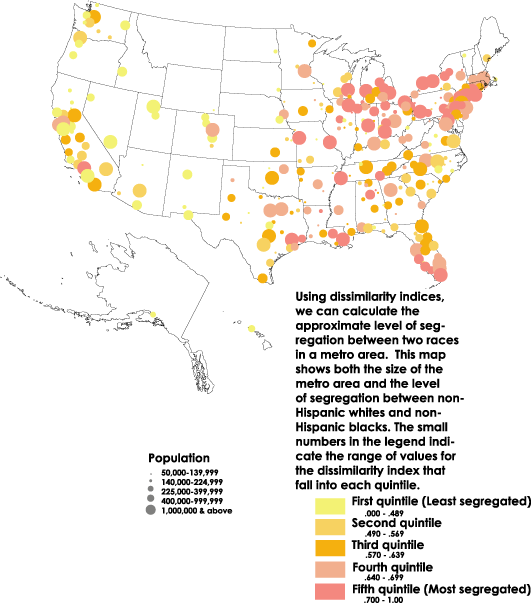
Source: William H. Frey and Dowell Myers’ analysis of Census 2000, and the Social Science Data Analysis Network (SSDAN).
This map displays the degree to which metropolitan areas are segregated in the United States
The size of the circles represents the population of the city, and the colour the degree of segregation.
Possible causes of segregation
The following have been proposed as causes of segregation:
- Housing discrimination
- Concentrated inner city poverty
- School locations
- Bank “redlining” (denying people loans based on where they live)
- Highway construction
- Racial prejudice
Survey results about personal preferences
In 2012, Erase Racism released a report entitled “Housing and Neighborhood Preferences of African Americans on Long Island”. Here is one key finding:
Despite the popular notion that blacks only want to live in communities with neighbors who share their own race or ethnicity, the telephone survey findings showed that given the choice, nearly all respondents chose a racially mixed neighborhood, with a large majority, 69%, who chose an even mix of 50% white and 50% black. Only 1% of respondents said that they would like to live in a neighborhood that is all black.
Schelling’s segregation model
In 1971, Thomas Schelling (Nobel prize in Economics, 2005) investigated the following model of segregation:\nocite{Schelling:1971}
- People live at a location in a grid.
- People are happy if at least a certain proportion of their neighbours are of the same type as themselves (and unhappy otherwise.)
- Unhappy people move to the nearest location that makes them happy.
Schelling’s segregation model
Schelling’s segregation model
The surprising finding was that, for a wide range of parameters, segregated neighbourhoods would always emerge, even though the preferences of agents in the model were compatible with mixed neighbourhoods!
This provides a how-possibly explanation showing that segregation can emerge even if none of the agent’s involve want that outcome.
The emergence of inequality, I
With reference to \cite{Nozick:1974}
Can we have a world in which extreme inequality does not exist?
In Anarchy, State, and Utopia, Robert Nozick provided an entitlement theory of distributive justice. This breaks the concept of distributive justice into three parts:
- The original acquisition of holdings. (What people start with.)
- The transfer of holdings between persons. (Trade/exchange.)
- The process by which a distribution is obtained.
The emergence of inequality, II
With reference to Nozick (1974)
More precisely, Nozick writes:
If the world were wholly just, the following inductive definition would exhaustively cover the subject of justice in holdings.
- A person who acquires a holding in accordance with the principle of justice in acquisition is entitled to that holding.
- A person who acquires a holding in accordance with the principle of justice in transfer, from someone else entitled to the holding, is entitled to the holding.
- No one is entitled to a holding except by (repeated) applications of 1 and 2.
\citep[pg. 151]{Nozick:1974}
The evolution of inequality, III
With reference to Nozick (1974)
The emergence of descriptive norms, I
Recall our discussion of social norms from lecture 3.
Bicchieri distinguished between several types of norm: descriptive, social, and moral. (I didn't talk about moral norms.)
Descriptive norms are the simplest — requiring only conditional preferences on the empirical expectations condition.
While this may provide a satisfactory account of how descriptive norms operate, it does not tell us about how they came to be. What is it about a given norm that caused everyone to start following it? \cite[pg. 4]{Muldoon/etal:2014a}
The emergence of descriptive norms, II
Muldoon et al. consider an idealised model of how a descriptive norm might emerge, looking at the formation of a standing ovation in a theatre.
Individuals have a social sensitivity $0\le \sigma_i\le 1$, measuring how responsive they are to others, as well as a inherent tendency $q_i$ to stand up.
The probability of person $i$ standing at time $t$ is: \[ P_i^{(t)} = \underbrace{\sigma_i(\text{``pressure from others''})}_{\text{This can take a variety of forms}} + (1-\sigma_i)q_i \]
The Muldoon et al. standing ovation model
The disappearance of languages, I
Let us adopt a simplified model of language communication as a coordination game.
People get a payoff if they are able to communicate with someone around them as follows:
| Do this | Do that | |
| Do this | (1,1) | (0,0) |
| Do that | (0,0) | (1,1) |
The disappearance of languages
The evolution of fair division
A simplified bargaining game, I
In their model, O’Connor et al. consider a simplified bargaining game. Suppose there is a resource of size 10, and people have to decide how to share it.
People have a strategy: Low (L), Medium (M), or High (H).
Suppose $M=5$ and that $L+H = 10$.
For two players, there are three rational outcomes:
- $(L,H)$
- $(M,M)$
- $(H,L)$
A simplified bargaining game, II
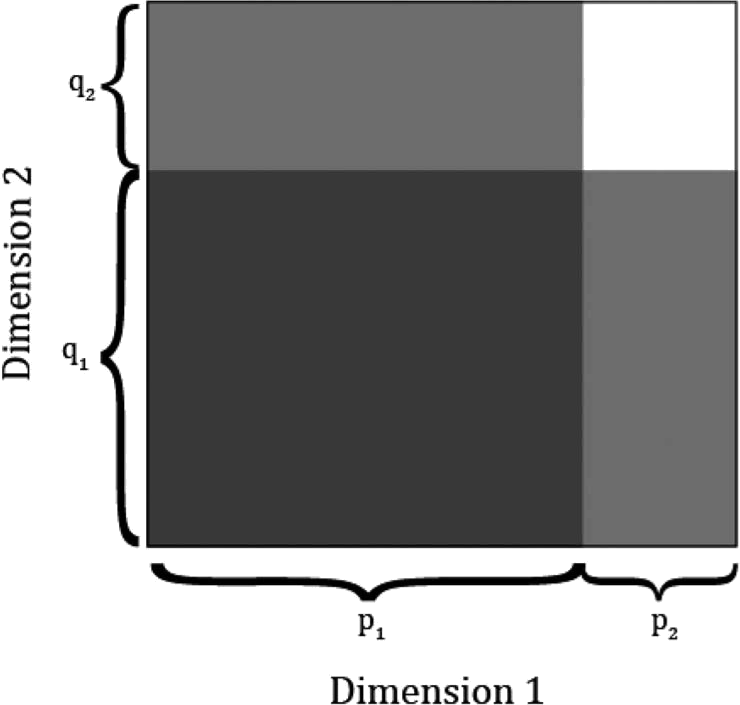
In addition, suppose that the population is partitioned along two different dimensions, with two categories along each dimension.
In the paper, O’Connor et al. refer to these categories using standard examples, e.g.,
- Men/Women
- White/Black
But, in truth, they could be anything.
 Men
Women
White
Black
Men
Women
White
Black
A simplified bargaining game, III
How do the evolutionary dynamics operate?
Suppose that this population regularly engages in two sorts of bargaining scenarios, for each of which only one of their identities becomes salient. For example, one arena of bargaining could occur in the workplace over salary, benefits, or workload and, in this arena, race could be particularly salient to the actors. Another arena of bargaining could occur in the marketplace over the cost of goods, and for this gender could be more salient. O’Connor, 2019, pg. 29
An even more simplified bargaining game, I
Minimal intersectionality
Here, O’Connor et al. note (emphasis mine): “To keep things tractable, we will focus on an even smaller version of the Nash demand game, where actors may only demand High or Low.”
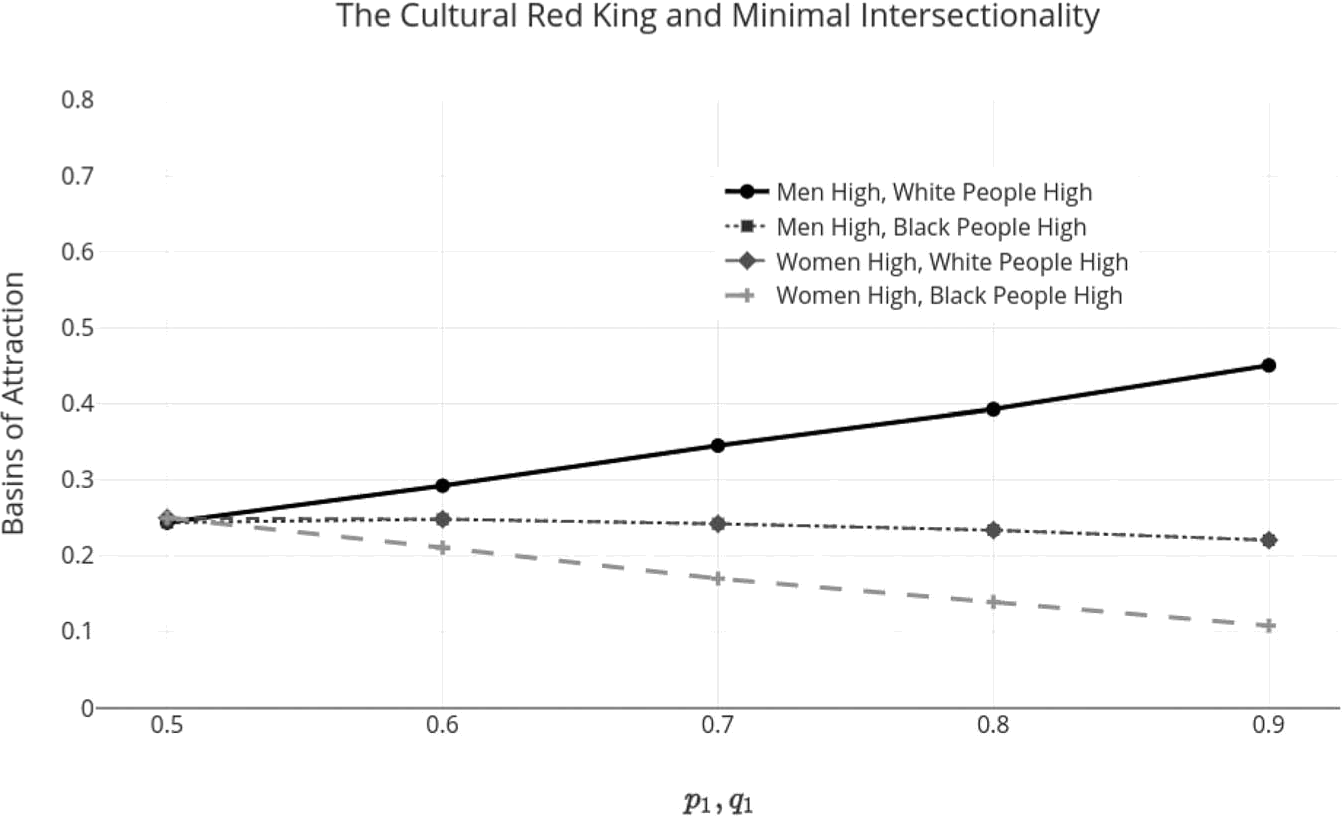
Figure 3. Proportions of four possible joint outcomes for minimally intersectional populations.
An even more simplified bargaining game, II
Moderate intersectionality
Now assume, though, that actors only learn socially from those in their intersectional type. At the market, for example, white men do not assume that any man is a good role model for them (even though gender is salient for interaction), but only adopt role models who also share their race. O’Connor et al., 2019, pg. 31
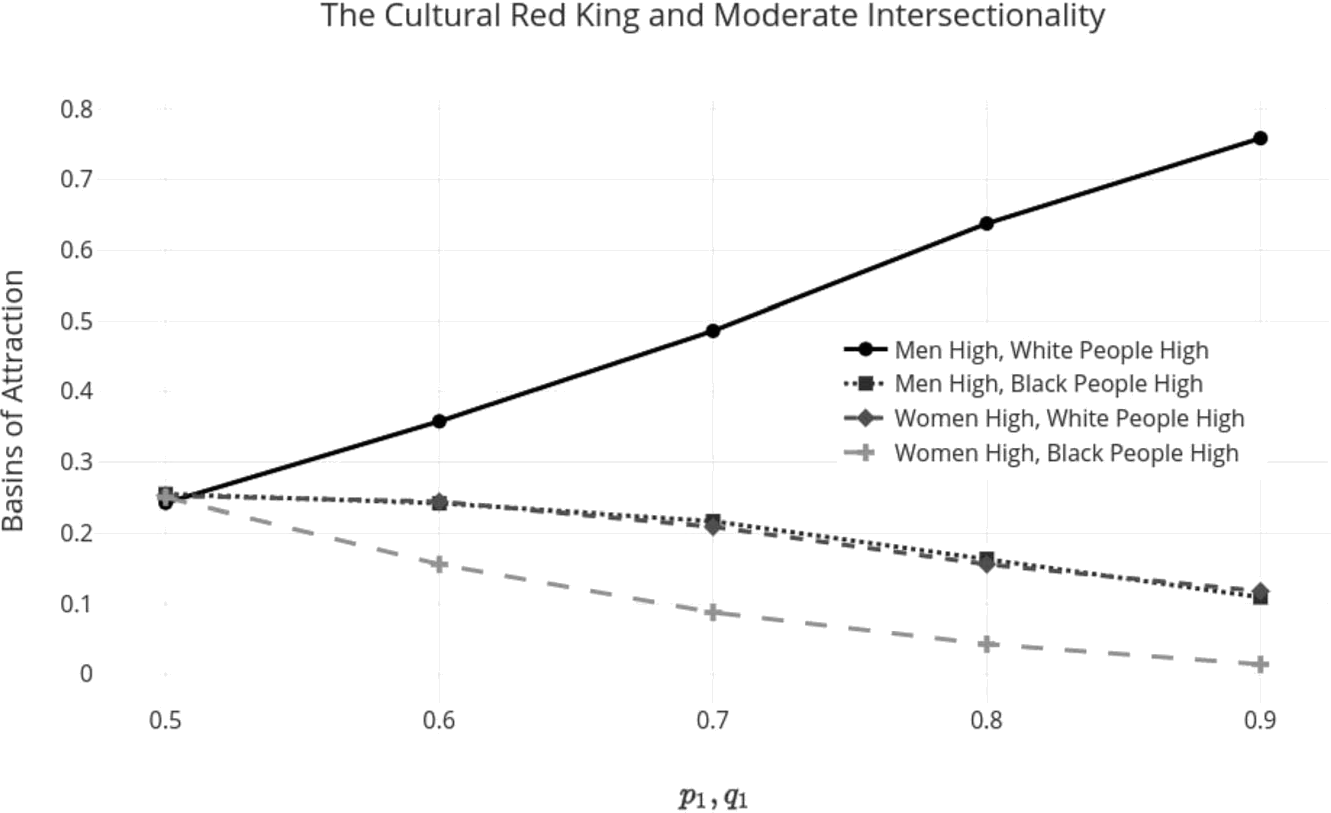
Figure 4. Proportions of four possible joint outcomes for moderately intersectional populations.
An even more simplified bargaining game, III
Strong intersectionality
We now assume that there is just one arena of interaction for our intersectional groups, and that within this arena only intersectional identities are salient for interaction. In other words, the individuals pay attention to intersectional identities in determining both (1) how to interact with bargaining partners and (2) which role models to choose.
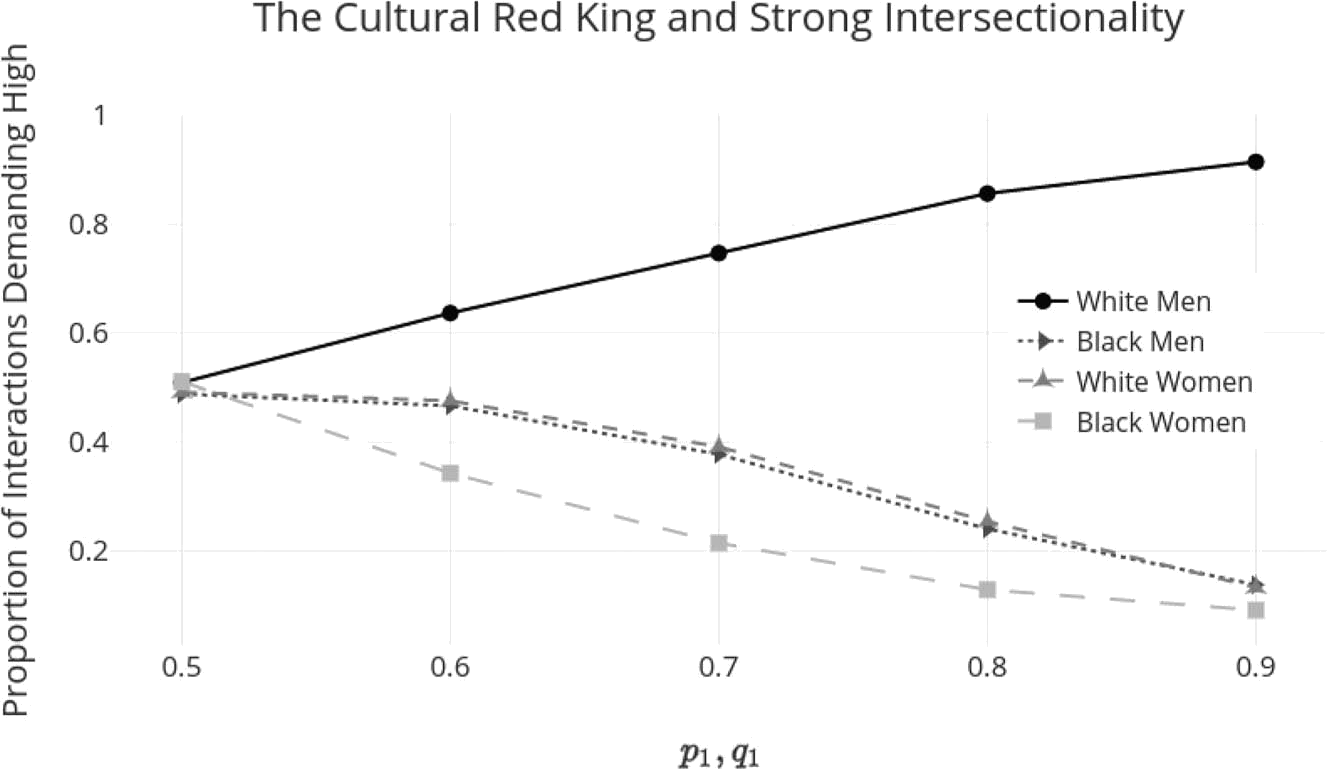
Figure 5. Average proportion of high demands for strongly intersectional populations.
Critical reflection, I
Consider what’s likely driving the results.
Men
Women
White
Black
Critical reflection, II
Is the correct interpretation really what they impute? Recall:
[S]imply by dint of small numbers alone, members of a minority group can be disadvantaged in the emergence of bargaining. O’Connor et al., 2019, pg. 27
- What is driving the result is simply the relative proportion of the size of the two groups.
- The fact that the labels are “Black/White” and “Men/Women” suggest that one read into the model connections with racism or patriarchy, but that goes beyond the formalism.
Critical reflection, III
In the Zucker et al. paper for this week, some additional variations on the O’Connor et al. model are considered.
In some cases, “minorities may actually be advantaged and intersectional minorities greater than additively advantaged”.
Question: If formal evolutionary models can help us understand why social practices might exist, what methodological recommendations, and cautions, do we need to pay attention to?