London School of Economics and Political Science
The Philosophy of Society?
You’ve probably heard about philosophy of the social sciences, but what is the philosophy of society?
There are several ways “the philosophy of society” can be understood. I use the term to refer to the following conjunction:
- How problems in some traditional areas of philosophy,
- take on a number of unique aspects when we take seriously the fact that
- we are fundamentally socially embedded creatures.
Here are the topics we will consider.
The topics
Personal identity, social identity.
How does our understanding of individual identity change given our membership in social groups?

Action, Intention, and Description.
What challenges arise when we try to attribute actions to those who belong to different social groups?
The topics, II
Social norms and individual choice.
Given that all of us are subject to social norms, how does that influence and modify our understanding of individual choice?
Social Constructivism and the Looping Effect.
Society is socially constructed, and so the reality of social phenomenon is different from the reality of other phenemonon. What difference does this make?
The topics, III
Cultural Evolution and Social Explanation
A number of people have attempted to explain social phenomenon using theories of cultural evolution. How does this form of explanation work, if and when it does?
Now, let's get started!
London School of Economics and Political Science
Learning Objectives
At the end of this lecture, you should be able to:
- Discuss several different senses of the term ‘identity’, and be able to explain how \cite{Parekh:2009} understands the terms personal identity and social identity.
- Explain ingroup/outgroup bias and how minimal group experiments show the ease with which this bias can be triggered.
- Explain Amartya Sen’s critique of Parekh’s view.
- Philosophically reflect on the moral and policy challenges ingroup bias raises for diverse societies.
Outline
- Personal identity
- Social identity
- Ingroup/outgroup bias
- Sen’s critique
Identity
Before we get to personal identity, let’s begin with identity.
There are two different senses of the term: qualitative identity, and numerical identity.
- Qualitative identity
- Two things are qualitatively identical if they share features. E.g., trucks and cars are qualitatively identical in that they are both motor vehicles.
- Numerical identity
- This requires complete qualitative identity, and can only hold between a thing and itself.
Two laws about identity ($=$)
Let’s put these on the table, as we’ll need them later…
- Leibniz’s law
- If $x = y$, then
This is very closely related to the point made by Parekh when he writes: “The identity of a thing consists in those constitutive features that define it as this or this kind of thing rather than some other, and distinguish it from others.”everything true of $x$ is true of $y$.
The converse of Leibniz’s law is more useful for our purposes:
- The Identity of Indiscernibles
- If everything that is true of $x$ is also true of $y$ (and vice versa), then it is the case that $x=y$.
Another form of the Identity of Indiscernibles says that if every property of $x$ is a property of $y$ (and vice versa), then $x=y$.
What’s a property? An attribute, feature, characteristic, etc. of a thing.
Personal identity I
There are a number of philosophical questions that are discussed under the topic of personal identity. Here are some standard ones:
- The Personhood Puzzle. What distinguishes a person from a nonperson? (I.e., people vs. rocks, or people vs. computers)
- The Persistence Problem. What makes me the same person as I was twenty years ago?
- The Characterisation Question. What is it that makes me the kind of person I am? (I.e., why am I not the same person as you?)
- The Evidence Enquiry. What accessible evidence is there to answer these questions?
Personal identity II
Some typical answers
-
The Personhood Puzzle.
Perhaps the most common answer is that possessing the right
kind of mental properties
is required to be a person.
This view has been around for hundreds of years. In An Essay Concerning Human Understanding, Locke defined a person as:
[A] thinking intelligent being, that has reason and reflection, and can consider itself as itself, the same thinking thing, in different times and places \citep{Locke:1690}
Personal Identity III
Some typical answers
-
The Persistance Problem.
This question has probably received the most philosophical attention over the years.
Typical answers fall into three categories:
- Psychological continuity. What determines persistence of identity is if the right kind of psychological relation holds between past states and the present state (e.g., continuity of memory).
- Physical continuity. What matters, here, is a physical relation (e.g., persistance of the body) not a psychological relation.
- Anticriterialism. There aren’t any necessary and sufficient conditions.
Some theories combine and .
Personal Identity IV
Some typical answers
- The Characterisation Question. This is most closely related to today’s topic.
What we will do, now, is:
- Discuss Parekh’s view from the reading “The Logic of Identity”.
- Consider some experimental results from social psychology.
- Briefly mention Sen’s critique from the reading “The Fog of Identity”.
Identity as a two-dimensional construct
In today’s reading, Parekh considers identity to have the following structure:
- Personal identity. This is each person’s “distinct [centre] of self-consciousness” with “an ineliminable inner life and a distinct sense of selfhood or subjectivity”.
- Social identity. Each person is a “socially embedded [member] of different ethnic, religious, cultural, occupational, national, and other groups”.
- Overall identity. One’s personal and social identity constitute the overall identity.
Identity as a two-dimensional construct, II
It's worth noting that the view Parekh presents in today’s reading is a simplified version of his theory from an earlier work \citep{Parekh:2008}.
In that earlier work, Parekh includes a third component based on a person's “awareness of oneself as a human being and asking how one should behave and live as a human being” \citep[pg. 283]{Parekh:2009}.
I actually prefer the simplified statement of Parekh's theory to the full version, as the universalistic considerations seem based on a normative moral ideal which isnecessarily part of a person’s identity.
In any case, here’s an argument why it doesn’t matter.
Identity as a two-dimensional construct, III
From social identity theory we know each person $i$ conceives of themselves as belonging to a family of groups $\mathscr{G}_i = \{G_1^i, \dots, G^i_{n_i}\}$, where each group in $\mathscr{G}_i$ contributes to $i$'s overall identity in various ways.
it is an open question as to whether $\mathscr{G}_i$ contains any reference to humanity as a whole.
Surely there are some people who do take their membership in the species homo sapiens seriously and ask “how one should behave and live as a human being,” but some people surely do not.
Identity as a two-dimensional construct, IV
In any case, it is formally extraneous to include, since those dependencies can be recovered by including all of humanity in the set $\mathscr{G}_i$ for those persons for whom it is relevant.
Interpreting Parekh
Parekh assumes a psychological continuity solution to the Persistence problem.
One’s personal identity is that set of mental properties which one takes to be constitutive of themselves. Those properties form the “distinct sense of selfhood” for the person. (This is his solution to the Characterisation question, for personal identity.)
N.B. One’s social identity is largely determined exogenously. You have limited control over it!
Question: Does that sound right to you?
Parekh’s theory of personal identity I
Personal identity is reflective, reason-based, and results from explicit acts of choice:
As [people] grow up, they seek to understand and make sense of themselves. They reflect on their beliefs, values, attitudes to life, qualities of character, and so on, and approve or disapprove of them. They might find that they harbour irrational prejudices or that some of their values and beliefs about the world are misguided, and might set themselves the task of overcoming these. This self-definition, the beliefs and values in terms of which they define or identify themselves as certain kinds of persons, constitutes their personal identity. \citep[pg. 268]{Parekh:2009}
Parekh’s theory of personal identity II
Parekh is not always consistent in what he says about the role played by choice, though. A literal reading of the previous quote (“this self-definition…”) would suggest all aspects of personal identity are choice-based.
Later, though, he says “Some identities might not involve choice”, e.g., in the case of one’s sexual orientation.
Question: What criteria determine whether choice is or is not required, for something to count as one’s personal identity? (We aren’t given any.)
Parekh’s theory of personal identity III
In addition, Parekh claims that personal identity has a unity and cohesion:
Personal identity plays an indispensible role in human life. It guides one’s choices and actions, and makes them coherent and consistent. \citep[pg. 270]{Parekh:2009}
Question: Do you agree with this? Let’s consider some cases where the intersection of social identity with personal identity creates tension.
Case 1: The social ties that bind
Suppose that Ada was born into an extremely conservative religious community that lives in a small town. Suppose also that she received limited education and that all of her friends live in that town. In addition, suppose the religious community will ostracize and disown any person who does not accept all principles of the faith. As Ada grows up, she loses all faith.
Here, it is entirely plausible that:
- The negative externalities of publicly rejecting her faith will make Ada pretend she still believes.
- This is an explicit choice, based on reflection, but will lead to a fragmented, incoherent life with a “divided self”.
Case 2: Code-switching
Suppose that John has a long-standing career as an elected official of the Republican party in the United States. Suppose that John also thought of himself as gay, which he hid to get ahead in politics, but he now thinks he has a more complex gender identity.
Here, it is entirely plausible that:
- John will code-switch, adopting radically different behaviours in different contexts.
- This is, again, reflective and an act of choice. But it strains credulity to describe John's life as “coherent and consistent”.
See “The Costs of Code-Switching”, Harvard Business Review (2019).\nocite{McCluney/etal:2019}
The relationship between identity and choice
While choice shapes identity, it is also the case that our identity restricts future choice.
[W]e build up a particular kind of character through our choices, and as we do, the range of choices diminishes and certain things never occur to us or are never deemed acceptable as possible alternatives. \citep[pg. 270]{Parekh:2009}
This fact is an important part of human moral development, for the choices don’t disappear — they remain as real, physical possibilities. But we don’t see them as such.
The source of social identity
Almost anything can be converted into a social identity, if people see it as important:
As social beings, human beings are involved in a variety of relationships, occupy different roles, and are members of different organisations, groups, and communities […] The range of social classification and the categories to which it gives rise are virtually limitless, and can be based on almost any human characteristic, trait, practice, relationship, and belief. \citep[pg. 272]{Parekh:2009}
The source of social identity
Ian Hacking makes a similar point in “The Looping Effect of Human Kinds” (which we will read on day 4):
There is little end to this process of self-ascription, or even ascription and then rejection: witness the current rejection of Hispanic by some of those for whom the term was invented, and replacement by Latino and other self-avowed subgroups […] A decade ago I injudiciously made a point sharply by contrasting multiple personality and homosexuality as human kinds. There would, I said, never be any split bars for people with multiple personality disorder. Well there are now multiple personality social groups, and I am told that there is indeed a multiple personality bar in Denver. \citep[pg. 382]{Hacking:1996}
Normativity and power I
One important difference between personal and social identity is that social identity involves, to a much greater degree, norms and power.
In particular, Parekh states that society often seeks:
- to ensure that people conform to expectations associated with a social category,
- to punish or sanction those who do not conform to such expectations,
- and to have
Recall that, for Parekh, a person simply inherits their social identity from the social categories they are assigned by the wider society. This does not mean that a person identifies, in any meaningful sense, with those social categories. If a social identity is internalised, then it becomes individually meaningful for the person. (There is an interpretive question as to whether this means that the social identity becomes part of their personal identity, or whether something else happens.)people internalise their social identities.
Normativity and power II
This raises a very important question: who controls the expectations associated with a certain social identity?
- Sometimes a single individual, or a set of individuals, fixes those expectations. (E.g., political party leaders, leaders of some religious groups, etc.)
- Sometimes social identities are emergent from the collective, not determined by any single person or (small) set of persons.
- Sometimes outgroup members fix expectations of ingroup members. (As when power asymmetries exist between ingroup and outgroup.)
In all cases, shifting expectations can alienate people from previously internalised social identities.
Normativity and power III
Here’s a favourite historical example of mine showing alienation occurring through the drift of social identity over time.
Trivia question: In the United States, which President:
- Created the Occupational Safety and Health Administration.
- Created the Environmental Protection Agency.
- Passed amendments to the Clean Air Act to improve air quality and reduce automobile emissions.
- Passed the Marine Mammal Protection Act, the Endangered Species Act, and the Safe Drinking Water Act, proposed expanding the Food Stamp program, and increased spending on Social Security, Medicare, and Medicaid benefits.
Answer: Richard Nixon, a Republican.
Normativity and power IV
What happens when a person belongs to multiple groups, and the social expectations associated with those multiple identities conflict?
- This creates a dilemma for the individual, for they cannot simultaneously satisfy all the expectations.
- If the inconsistency results from factors beyond their control, this can result in a strong sense of injustice, for the person can be forced to choose and prioritise which social identity matters most to them, when they may not want to.
These conflicts become amplified when we introduce the concept of authenticity.
Parekh’s two questions
Much of Parekh’s article explores two questions at length. Due to limits of time, I won’t consider them in detail, even though they are important.
- Since obsessive preoccupation with a single identity is unusual and debilitating, how do those involved come to be persuaded by it and justify it to themselves and others?
- Under what social circumstances does it acquire sway over vast masses of human beings and appear natural to them?
He explores these using religious identity, but note that represents any dominant social identity a person can be preoccupied with.
The problem of a dominating social identity
What can go wrong when a single social identity dominates?
Individuals then see themselves, their society and the world from a single perspective, and not only fail to notice several aspects of them, but take a highly skewed and distorted view of those they do. They divide humankind along a single axis, see individuals and groups as friends or foes, and ignore their commonalities and overlapping ties. \citep[pg. 276]{Parekh:2009}
This is what I called ‘Joshua’s question’ in the background readings for this week.
The Robbers Cave experiment I
In 1954, Muzafer Sherif conducted an experiment that would become famous.
The experiment was conducted at a camp for 11–12 year-old boys at Robbers Cave (said to be the hideout of the famous outlaw Jesse James).
The purpose was to examine what happened when two groups, tightly bound by connections of friendship, engaged in competition.
The Robbers Cave experiment II
Phase 1. Two groups of boys were put in separate cabins, engaging in independent activities (cooking, camping, etc.)
First observation:
Within each group different members quickly took on different responsibilities, and obvious leaders emerged. The groups developed their own codes, nicknames, and jargon, and defined their territory by naming various landmarks. They also kept their members in line by ridiculing those who did not adhere to group rules and norms. \citep[pg. 37]{Hogg/Abrams:1988}
The Robbers Cave experiment III
Phase 2. The two groups were pitted against each other in sporting competitions for prizes.
Second observation:
The initial spirit of goodwill disappeared as the tournament progressed. The boys began to taunt and jeer at members of the other group, denouncing them as ‘snakes’ and ‘stinkers’. By the end of the tournament the two groups virtually refused to talk to each other and began to launch secret raids and attacks on each other’s cabin. \citep[pg. 37]{Hogg/Abrams:1988}
The Robbers Cave experiment IV
In an earlier experiment, in 1953, the experiment had to be aborted due to concerns that the level of animosity between the two groups reached such an extent that the safety of the boys was endangered!
So what?
Doesn’t this just show that people favour their friends, and that personal relationships are more important to people than strangers?
No. Henri Tajfel used the minimal group paradigm to show that ingroup bias occurred there, too. A minimal group is defined as follows:
There is neither conflict of interest nor previously existing hostility between the ‘groups’. No social interaction takes place between the subjects, nor is there any rational link between economic self-interest and the strategy of ingroup favouritism. Thus these groups are purely cognitive and can be referred to as minimal. \citep[pp. 28–39]{Tajfel/etal:1979}
How minimal is minimal?
In the original experiments \citep{Tajfel/etal:1971} told subjects they were grouped according to whether they shared a preference for the paintings of Paul Klee or Vasily Kandinsky. (It was actually random.)
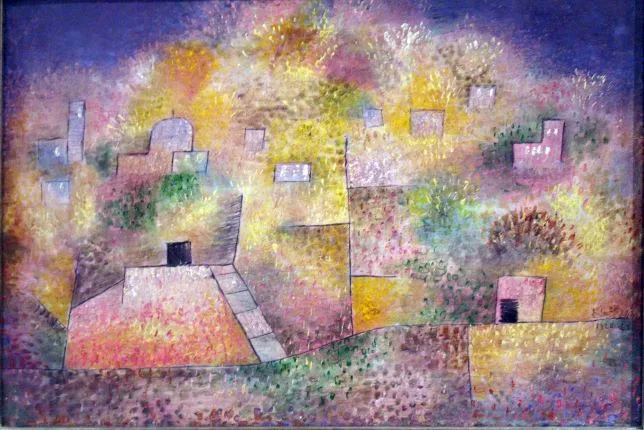
Jardin d'agrément oriental, 1925, by Paul Klee
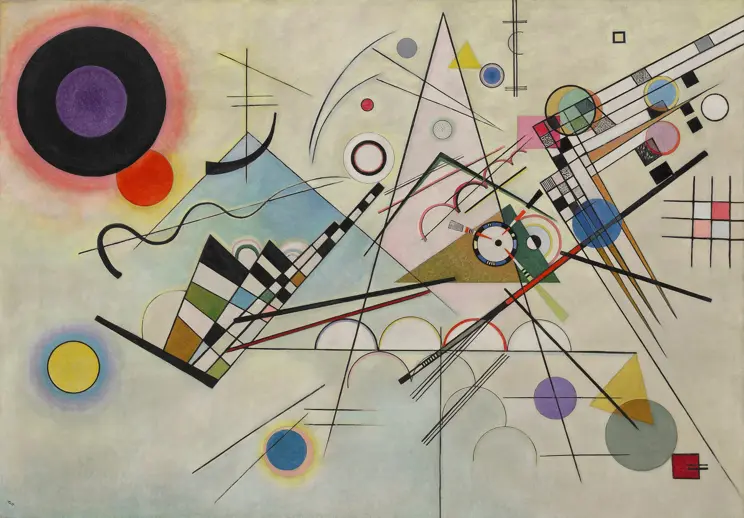
Komposition 8, 1923, by Vasily Kandinsky
Summary
- Results from minimal group experiments suggests that we have a deep-seated tendency to favour ingroup members.
- This bias is triggered even when people know that the group structure is arbitrary and has no meaningful significance to them.
- The Sherif experiments show that group competition can lead to animosity and violence where none existed before.
And we live in a world where social categories — which divide people into groups — is a hugely important part of people’s identity.
Sen’s critique
Sen has three objections to Parekh’s view.\nocite{Sen:2009}
- Our social identities can change without our “overall identity” changing. So the relationship between social identity and ”overall identity” must be different from what Parekh suggests.
- Too much emphasis on social identity is dangerous because it leads people to think that they cannot understand the world from an outside perspective.
- If our personal identity depends on our social identity, that can cause people to be unwilling to challenge or deviate from activities of other group members.
Concluding questions for reflection
- How might Parekh respond to Sen’s criticism from ?
- Do the findings of Sherif and Tajfel support Sen’s worry from ? If so, should we change how we think about our social identity?
- Is Sen correct in saying: “The distancing of personal identity from one’s social affiliation is an extremely important issue in making the violent world in which we live a little less turbulent”?
I look forward to discussing these issues, and more, in class.