London School of Economics and Political Science
Learning Objectives
At the end of this lecture, you should be able to:
- Describe several different theories of social norms, identifying some of their theoretical shortcomings.
- Explain why it is important to develop a theory of social norms which is compatible with rational choice theory.
- Discuss Bicchieri’s theory of social norms.
- Use Bicchieri’s theory to distinguish several types of collective behaviour.
Outline
- What we talk about when we talk about norms
- A motley zoo of theories
- Bicchieri’s theory of social norms
From situations to social norms
Over the last two lectures, we examined how social situations influence individual behaviour in ways which complicate our understanding of who we are and what we do.
This week, we will explore how our social nature influences individual behaviour much more directly, by affecting individual choice behaviour.
That is, we will consider social norms.
Question: What is a social norm?
Disambiguating ‘norm’ \citep{Brennan/etal:2013}
The word ‘norm’ has several different senses in ordinary English.
- A statistical regularity
- This sense of ‘norm’ just refers to what is common. E.g. “In France, having two children is the norm for a family.” This usage may have no normative content at all.
- An objective normative principle
- When philosophers talk of ‘norms’ of morality or rationality, they often mean universally valid rules or principles of that kind.
- An accepted normative principle
- E.g., “It is the norm amongst the Finnish not to stand too close to people.” This has normative content, but it can be contextually variable.
What we talk about when we talk about norms
With apologies to Raymond Carver
- \cite{Parsons:1937}. A norm is “a verbal description of a concrete course of action […] regarded as desirable, combined with an injunction to make certain future actions conform to this course.”
- \cite{Terry/Hogg:1996}. “People are influenced by norms because norms prescribe the context-specific attitudes and behaviors appropriate for group members.” In addition, “the perceived norms of a behaviorally relevant reference group will become relevant to behavioral choice only when the group membership is an important component of one's self-definition.”
- \cite{UllmannMargalit:1977}. A norm is a Nash equilibrium of an underlying collective action problem.
- \cite{Brennan/etal:2013}. A norm is a cluster of normative attitudes in a group, along with the knowledge that such a cluster of attitudes exists.
A sociological theory of norms I
\cite{Parsons/Shils:1951}
Theory: The common values of a society are embedded in norms; conforming to these norms maintains social order and the functioning of the social system.
Question: Why do people conform to norms?
Answer: As children are socialised, they unconsciously adopt this shared value system as a constitutive element of their personality.
The internalization of norms leads to:
- Norm-abiding behaviour being seen as good (or appropriate).
- Deviating from a norm causing people to feel shame or guilt.
A sociological theory of norms II
\cite{Parsons/Shils:1951}
This theory has several implications.
- Because norms assure social order and stability (this is a functionalist account), they will change slowly.
- People’s normative beliefs will be positively associated with the corresponding action.
- When norms are internalized, a person’s beliefs about other peoples’ behaviour will have no effect on their choice to conform.
What does the science say?

Testing Parson’s theory of social norms
A criticism of : Because norms assure social order and stability, they will change slowly.
Painful and dangerous footbinding afflicted most Chinese women for a thousand years, and reform-minded Chinese women at one time “agreed that footbinding was of no use, but could only be given up by degrees” […] Yet footbinding ended, for the most part, in a single generation. \citep[pg. 999]{Mackie:1996}
In Tinghsien, a conservative rural area 125 miles south of Beijing:
Testing Parson’s theory of social norms
A criticism of : That people’s normative beliefs are positively associated with the corresponding action.
There are also behaviors that can be explained only by the existence of norms, even if the behavior prescribed by the norm in question is never observed. In his study of the Ik, Turnbull (1972) reports that these starved hunter-gatherers tried hard to elude situations where their compliance with norms of reciprocity was expected. Thus they would go out of their way to avoid being in the role of gift-taker. A leaking roof would be repaired at night, so as to ward off offers to help and future obligations to repay the favor […] Much of the Ik’s behavior can be explained as a successful attempt at eluding existing reciprocity norms. \citep[pg. 9]{Bicchieri:2005}
Testing Parson’s theory of social norms
A criticism of : When norms are internalized, a person’s beliefs about other peoples’ behaviour will have no effect on their choice to conform. \nocite{Warner/DeFleur:1969}
Warner and DeFleur (1969) reported that the main variable affecting discriminatory behavior is one’s belief about what society (e.g., most other people) says one should do, as opposed to what one personally thinks one should do. \citep{Bicchieri/etal:2023}
Instrumental rationality and social norms
All the theories of social norms we have considered so far are grounded in sociology and social psychology.
Is it possible to develop an account of social norms from the tradition of rational actor theory?
Neoclassical economics will be dethroned if and when […] sociological theory comes up with a simple and robust theory of the relation between social norms and instrumental rationality. Until this happens, the continued dominance of neoclassical theory is ensured by the fact that one can’t beat something with nothing. \citep[pp. 26–27]{Elster:1986c}
A game-theoretic model of norms
\cite{UllmannMargalit:1977}
Rational choice theory studies the decisions of individuals in isolation. Game theory studies interdependent decision problems.
Consider the following problem: what side of the road to drive on?
| Left | Right | |
| Left | \tuple{1, 1} | \tuple{0, 0} |
| Right | \tuple{0, 0} | \tuple{1, 1} |
A Nash equilibrium is a set of mutual best responses for each person.
(Left, Left) and (Right, Right) are equally good outcomes.
This is a convention.
A game-theoretic model of norms
\cite{UllmannMargalit:1977}
Some philosophers, like Edna Ullman-Margalit and Cristina Bicchieri (earlier work), have suggested that social norms should be understood as a Nash equilibrium of a social interdependent decision problem.
Benefits of this approach:
- Captures some important aspects of what norms are.
- Reconciles rational choice theory with the sociological study of norms.
Weaknesses of this approach:
- All social norms end up being rational (and rationalisable).
- If I know everyone else follows the norm, I have no special incentive to do so.
A game-theoretic model of norms
\cite{UllmannMargalit:1977}
In addition, the simple game-theoretic model cannot handle cases like the following:
| Cooperate | Defect | |
| Cooperate | \tuple{2, 2} | \tuple{0, 3} |
| Defect | \tuple{3, 0} | \tuple{1, 1} |
- This is the well-known Prisoner's Dilemma game.
- Higher payoffs are better.
- Defect is what rational, self-interested agents choose.
Many societies have a norm of cooperation, but that is not a Nash equilibrium in this game.
Conformity theories of norms I
\cite{Brennan/etal:2013}
An important point about social norms seems to be the fact that our compliance depends, in some way, on our knowledge of other people’s attitudes.
-
A significant proportion of the members of $G$ have
$P$-corresponding normative attitudes; and -
A significant proportion of the members of $G$ know that a significant proportion of the
members of $G$ have
$P$-corresponding normative attitudes.
Conformity theories of norms II
\cite{Brennan/etal:2013}
If that’s what norms are, what are norms for? Here are three possibilities:
Facilitating coordination. Helping us select a mutually beneficial outcome when there are several equally good alternatives available.
Facilitating cooperation. Helping us select a mutually beneficial outcome when our interests are opposed to one other, but not impossibly so.
Holding us accountable to each other. Enabling us to demand and expect things from each other, and to make claims.
Conformity theories of norms II
\cite{Brennan/etal:2013}
There is an important shortfall in Brennan et al.’s theory.
Every person may have $P$-corresponding normative attitudes (concerning others), and know that other people have $P$-corresponding normative attitudes (concerning others), but not care about following themselves.
This suggests that Brennan’s definition doesn’t fully capture what we mean by a social norm.
Bicchieri’s theory of social norms I
\cite{Bicchieri:2005, Bicchieri:2017} builds her theory of social norms around two key concepts: preference and expectation.
- Preferences can be unconditional or conditional.
- An unconditional preference means one’s choice is not influenced by knowing how other people act in similar situations or what they approve/disapprove of.
- A conditional preference means one’s choice is influenced by those factors.
Bicchieri’s theory of social norms I
\cite{Bicchieri:2005, Bicchieri:2017} builds her theory of social norms around two key concepts: preference and expectation.
 An expectation is a belief about what will happen, or is likely to happen.
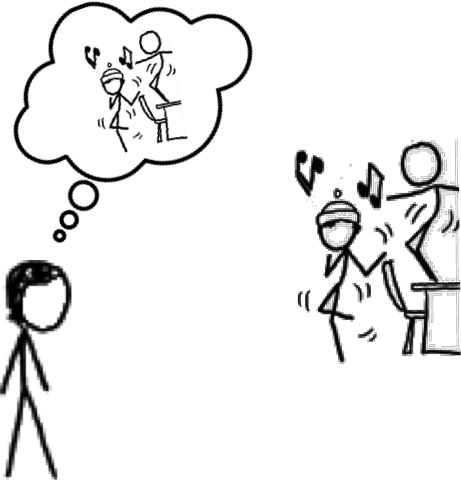
 An social expectation is an expectation about other people’s behaviours
or beliefs.
An social expectation is an expectation about other people’s behaviours
or beliefs.
Bicchieri’s theory of social norms II
Let $R$ be a rule for situations of type $S$. Then $R$ is a social norm in a population $P$ if there exists a sufficiently large subgroup $P_{cf} \subseteq P$ such that for each individual $i$ in $P_{cf}$ the following hold:
Contingency: $i$ knows that $R$ exists and applies to $S$.
Conditional preference: $i$ prefers to conform to $R$ when:
$i$ believes that enough people in $P$ conform to $R$ in $S$.
$i$ believes that enough people in $P$ expect $i$ to conform to $R$ in $S$, and may sanction $i$ for nonconformity.
Customs, descriptive norms, and social norms
There are important differences between types of collective behaviour.
 A custom is a pattern of behaviour such that individuals
(unconditionally) prefer to conform to it to meet their needs.
A custom is a pattern of behaviour such that individuals
(unconditionally) prefer to conform to it to meet their needs.
Customs, descriptive norms, and social norms
There are important differences between types of collective behaviour.
 A descriptive norm is a pattern of behavior such that individuals prefer to conform
to it on condition that they believe that most people in their reference network
conform to it.
A descriptive norm is a pattern of behavior such that individuals prefer to conform
to it on condition that they believe that most people in their reference network
conform to it.
Here, it is just the empirical expectation which applies.
Customs, descriptive norms, and social norms
There are important differences between types of collective behaviour.
 A social norm is a rule of behavior such that individuals prefer to conform to it on
condition that they believe that (a) most people in their reference network conform to it, and
(b) that most people in their reference network believe they
ought to conform to it.
A social norm is a rule of behavior such that individuals prefer to conform to it on
condition that they believe that (a) most people in their reference network conform to it, and
(b) that most people in their reference network believe they
ought to conform to it.
Here, both the empirical and normative expectations apply.
Social identity theories of norms I
\cite{Turner/etal:1987}
Theories in this tradition attempt to improve on Parsons’ theory by shifting the motivation from internalised norms to social identity.
According to \cite{Tajfel:1981}, when we self-categorise as a member of a group, our perception of ourself changes, as well as our motives for acting.
Question: How does our motive for acting depend, precisely, on our group membership?
Social identity theories of norms II
\cite{Turner/etal:1987}
According to Turner’s self-categorisation theory, categorisation invokes a sterotype, which becomes salient to the person.
A stereotype is a set of mental, psychology, and physical characteristics that are attributed to a “typical” group member.
Associated with a stereotype is a set of “scripts” about how to behave in certain situations.
When a person self-categorises as a group member, they begin to see themselves as similar to other group members along the stereotypical dimensions.
Social identity theories of norms III
\cite{Turner/etal:1987}
A social norm is activated as follows:
An individual’s self-categorisation as a group member invokes a stereotype.
Certain interests and goals are embedded in the stereotype.
Self-categorisation thus leads to the individual taking on the interests and goals embedded in the stereotype.
A social identity theory of norms IV
\cite{Turner/etal:1987}
Notice that this theory makes importantly different predictions from the sociological theory.